The Complete Guide to Why Your Brain Feels Slower in Winter
Quick Answer: The winter cognitive dip is mostly downstream of three things: less light reaching your eyes, which disrupts circadian timing and therefore sleep; shifted sleep timing without shifted wake times, producing chronic mild sleep restriction; and reduced mood and activity, both of which consume attentional resources. Vitamin D, temperature, and viral illness contribute at the margins. The interventions with the best support are morning light exposure, protecting sleep timing, and maintaining physical activity through the dark months.
The effect is real, but the mechanism is not what most people assume - it is far more about sleep timing than about temperature or vitamins.
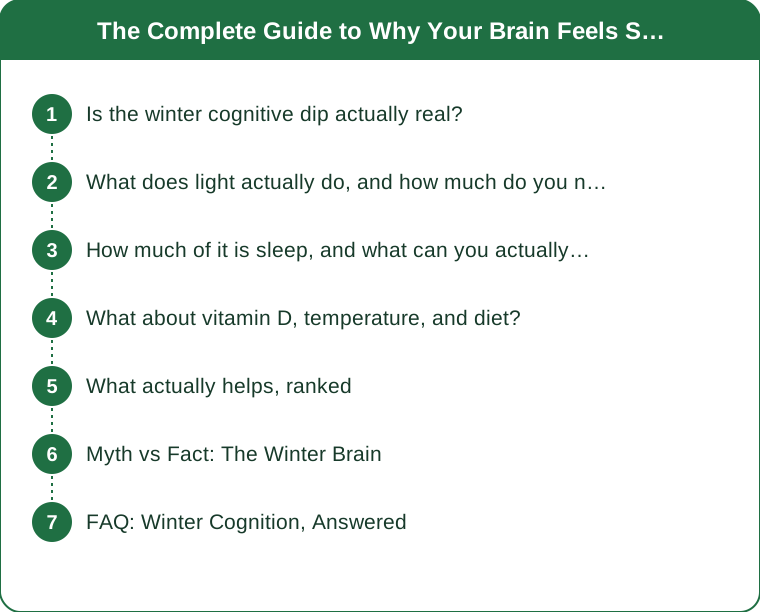
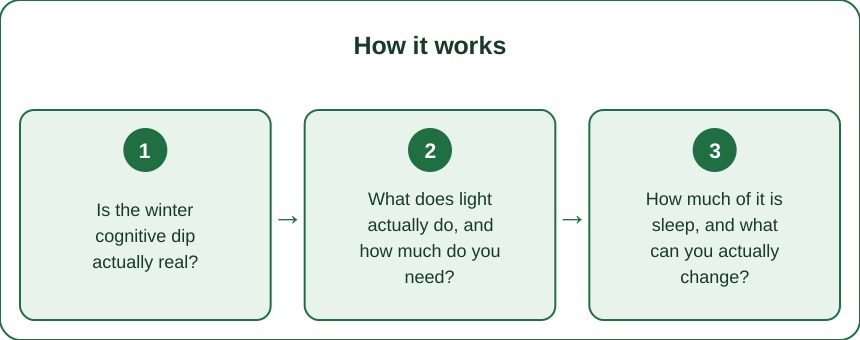
Is the winter cognitive dip actually real?
Something real is happening, though the picture from the research is more nuanced than the popular version.
Seasonal variation in mood is well established. Seasonal affective disorder is a recognised condition, and a much larger group of people experience milder seasonal mood changes without meeting diagnostic criteria. Since mood affects attention, motivation, and working memory, some of the cognitive effect travels through mood.
Seasonal variation in cognition specifically has been studied, with some research finding seasonal patterns in performance on attention and memory tasks, and in the brain activity underlying them. The findings are not uniform across studies, and the size of the effect in everyday life is debated. What is much less debated is the chain of causes underneath it.
The most robust part of the picture is sleep. Light is the primary signal that sets circadian timing. In winter, the morning light signal arrives later and is weaker, particularly for anyone who wakes and commutes in darkness. Circadian timing drifts later while alarm clocks do not, which produces a mild, chronic mismatch - later sleep onset, same wake time, less sleep.
Mild chronic sleep restriction has well-documented effects on attention, working memory, and reaction time, and people are notoriously poor at noticing how impaired they are. This alone accounts for a great deal of what people call winter brain fog, without needing any additional mechanism.
Add reduced physical activity, less time outdoors, more indoor time, and the higher circulation of respiratory viruses, and the effect compounds from several directions at once.
What does light actually do, and how much do you need?
Light entering the eye is the dominant input to your body clock, and indoor light is far dimmer than most people realise.
Specialised cells in the retina respond to light - particularly short-wavelength blue light - and signal the brain’s master clock. That signal sets the timing of the sleep-wake cycle, hormone release, body temperature rhythms, and alertness through the day.
The intensity difference between indoors and outdoors is enormous. A well-lit office might be a few hundred lux. An overcast winter day outdoors is typically several thousand lux, and a bright sunny day can be tens of thousands. Even a dull, grey, rainy morning outside is far brighter than a comfortable indoor room, which is the single most useful fact in this whole area.
Timing matters as much as intensity. Light in the morning advances the body clock, helping you feel sleepy earlier and wake more easily. Light in the evening delays it. A dark morning followed by a brightly lit evening indoors is precisely the wrong pattern, and it is the default pattern of a modern winter.
The practical target: get outside within an hour or two of waking, for 15 to 30 minutes if you can, even under cloud. No sunglasses, no window in the way - glass and sunglasses both cut the effective intensity substantially.
Light therapy lamps are used for seasonal mood symptoms, typically in the morning, and are generally considered a first-line option for seasonal affective disorder. If you are considering one for low mood specifically, discuss it with a clinician first, since timing and suitability vary, and some conditions and medications require caution. This is general information, not medical advice.
How much of it is sleep, and what can you actually change?
Most of it, and the changeable parts are timing and consistency rather than duration.
The winter pattern that causes trouble is a later sleep onset with an unchanged wake time. Weekends make it worse, because the natural tendency is to sleep later at both ends, which pushes the clock further out and makes Monday harder - a pattern sometimes described as social jetlag.
What helps, in rough order of effect:
- A consistent wake time, seven days a week. Wake time anchors the whole system far more effectively than bedtime does. This is the single highest-value sleep intervention available, and it is free.
- Morning light immediately after waking, which reinforces the anchor.
- Dimmer evenings. Lower the light levels in the last hour or two - lamps rather than overheads, warmer colour temperature, screens dimmed. You are trying to make the evening look like evening.
- Protecting the sleep window rather than the sleep. Being in bed with the lights off for an adequate window is what you control; falling asleep is not.
What matters less than people think: the exact number of hours, which varies between individuals, and evening screen use, which is a real but generally smaller effect than the total evening light level in the room.
One winter-specific trap: the temptation to go to bed early because it is dark and then lie awake. Sleep pressure builds with hours awake, and going to bed two hours earlier than usual generally produces frustration rather than sleep. Keep the bedtime roughly where it was and fix the mornings instead.
If daytime sleepiness is severe, or if low mood persists for weeks, speak to a clinician. Several conditions - including sleep apnoea, thyroid problems, iron deficiency, and depression - produce symptoms that look like winter brain fog and are treatable. This is general information, not medical advice.
What about vitamin D, temperature, and diet?
All three contribute at the margins, and all three are frequently overstated as the main cause.
Vitamin D. Skin production from sunlight drops substantially at higher latitudes through autumn and winter, and deficiency is common. Deficiency is associated with fatigue and low mood, and many national guidelines recommend supplementation during the darker months. Whether supplementing improves cognition in people who are not deficient is much less clear, and the evidence for large cognitive effects from supplementation is weak.
The sensible position: follow your country’s guidance on winter supplementation, get tested if you have reason to think you are deficient, and do not expect a supplement to resolve a problem whose main driver is sleep timing.
Temperature. Cold rooms affect comfort and concentration, and a cold bedroom is generally good for sleep while a cold working environment is not. Working in a room that is too cold measurably affects manual dexterity and comfort, and the effect on concentration is mostly through distraction.
Diet. Winter eating patterns shift toward denser, warmer, more carbohydrate-heavy foods. The largest practical effect is on energy stability through the afternoon - a large carbohydrate-heavy lunch with little protein reliably produces a bigger post-lunch dip. Adding protein and vegetables to lunch is a small change with a noticeable effect on the afternoon.
Hydration falls in winter because people drink less when it is cold, and mild dehydration affects concentration. Warm drinks count, which is the easy fix.
Alcohol deserves a mention, since intake tends to rise through the darker months and the social season. It fragments sleep architecture and produces early-hours waking, which lands directly on the mechanism that is already under strain.
What actually helps, ranked
In order of how much difference each one makes relative to the effort involved.
1. Morning light, outdoors, within an hour or two of waking. Fifteen to thirty minutes, no sunglasses, cloud is fine. This addresses the root cause rather than the symptoms, and it costs nothing but the time. Combine it with a walk and you get two interventions in one.
2. A fixed wake time, seven days a week. Including weekends. The most powerful single lever on sleep quality, and the hardest to accept.
3. Maintaining physical activity. Moderate exercise supports mood, sleep quality, and attention, and it is the first thing that disappears when the weather turns. A short walk at lunchtime, in the brightest part of the day, does more than any equipment or supplement on this list - it delivers light, movement, and a break from near-focus work simultaneously.
4. Dimmer evenings and a consistent wind-down. Lamps instead of overheads, screens dimmed, and the same sequence each night.
5. Fixing the workspace lighting. A bright screen in a dark room is a genuine source of eye fatigue that gets attributed to tiredness. Add a light behind the monitor so the screen is not an isolated bright rectangle, and match screen brightness to the room.
6. Protein at lunch, to flatten the afternoon dip.
7. Vitamin D per your national guidance, and a test if you have reason to suspect deficiency.
8. Consider a light therapy lamp if seasonal mood symptoms are significant - discussed with a clinician first.
What to expect: these do not eliminate the seasonal effect. They reduce a compounded problem back to a manageable one, and the difference is most noticeable in late January, several weeks after you started.
Myth vs Fact: The Winter Brain
Myth: Winter brain fog is caused by vitamin D deficiency. Fact: Deficiency is common and worth addressing, but the dominant mechanism is light-driven circadian disruption and the sleep restriction that follows. A supplement does not fix a timing problem.
Myth: You need more sleep in winter. Fact: Individual sleep need does not change much seasonally. What changes is timing - people tend to want to sleep and wake later. The problem is the mismatch with fixed schedules, not the total requirement.
Myth: A light box has to be used for hours. Fact: Typical protocols are far shorter, and specifics vary by device and by individual - which is exactly why it is worth discussing with a clinician rather than improvising.
Myth: Getting outside on a grey day is pointless. Fact: An overcast winter day outdoors is dramatically brighter than any normally lit indoor room. This is the most useful and least believed fact in the whole topic.
Myth: Brain training apps help with winter fog. Fact: Transfer from trained tasks to general cognition is consistently weak. Time spent on them would do more as a walk outdoors.
Myth: You just have to push through until spring. Fact: Several of the drivers are modifiable, and the ones with the best evidence - light timing and sleep consistency - are free. And if low mood is persistent and interfering with your life, that is worth a clinical conversation rather than an endurance test. This is general information, not medical advice.
FAQ: Winter Cognition, Answered
How long does it take for morning light to make a difference?
Circadian shifts take days rather than hours. Most people notice a change in how easily they wake within one to two weeks of consistent morning exposure.
Does a dawn simulator alarm work?
Many people find them helpful for waking, and they are a reasonable option when getting outside early is not possible. They are dimmer than daylight, so they complement outdoor light rather than replacing it.
Is it worth taking a vitamin D test?
If you have symptoms, limited sun exposure, darker skin at a high latitude, or other risk factors, a test tells you far more than guessing. Follow your clinician’s advice on dosing.
Why do I feel worse in January than in November?
The effects accumulate - weeks of shortened sleep, less activity, and reduced light exposure compound, and January adds the end of the social season. It is a cumulative pattern rather than a temperature one.
When should I see a doctor?
If low mood persists for weeks, if it affects your daily functioning, or if fatigue is severe. Several treatable conditions present this way, and seasonal affective disorder itself is treatable.
TL;DR:
- The winter dip runs mostly through light, circadian timing, and the mild sleep restriction that follows
- An overcast day outdoors is far brighter than any indoor room - get out within two hours of waking
- A fixed wake time seven days a week is the strongest single lever, and it is free
- Vitamin D, temperature, and diet contribute at the margins and are commonly overstated
- Persistent low mood or severe fatigue deserves a clinical conversation, not an endurance test
The useful reframe is that this is not a mysterious seasonal fog but a chain of specific, mostly modifiable causes - and the two interventions at the top of the chain, morning light and a consistent wake time, cost nothing and start working within a fortnight.
Keep Reading
This article is for general informational purposes only and is not medical advice. Always consult a qualified health professional for guidance specific to you.