The Complete Guide to Rebuilding Focus After a Summer of Fragmented Days
Quick Answer: A summer of interrupted days trains you to work in short bursts with frequent switching, and that pattern persists into September even when the interruptions stop. Attention is not a fixed trait - it responds to what you have been practising. Rebuilding takes roughly two to four weeks of deliberately structured work, starting from where you actually are (often 15 to 20 minutes) rather than where you were in June. This guide covers what changed, how to test your current capacity, and a four-week rebuild.
It is the second week of September, the house is quiet, and you have read the same paragraph four times.
Nothing is wrong with you. You have spent ten weeks practising a completely different skill, and you got good at it.

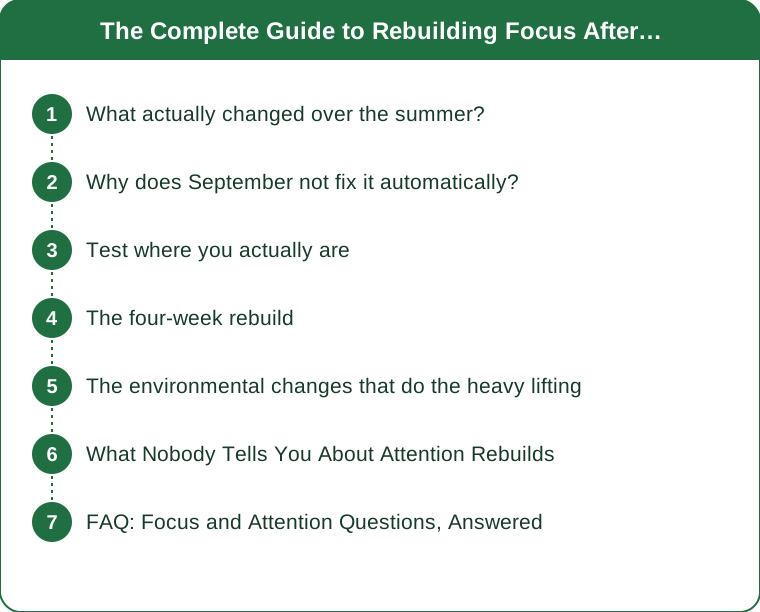
What actually changed over the summer?
You practised switching, and you got better at switching. That is the honest summary, and it is worth taking seriously rather than treating as a vague sense of being rusty.
Consider what a summer with children at home, or a lighter work schedule, or a series of holidays actually consists of. Work happens in fragments between other things. A task is started, interrupted, resumed twenty minutes later. Attention is repeatedly pulled outward and then re-gathered.
Do that for ten weeks and several things adapt.
Your working pattern shortens. You begin unconsciously structuring tasks into pieces that fit the available fragment, which is a sensible adaptation and a hard one to undo in a week.
Your tolerance for sustained difficulty drops. Deep work involves a period of discomfort before the material becomes interesting. If every session was going to be interrupted anyway, you stopped pushing through that phase, because there was no point.
Your check-in habits increase. Frequent interruption trains frequent monitoring. Phone checks, email checks, and glances at a notification rise, because during summer they were often genuinely relevant.
Your day lost its edges. Structured days provide external boundaries - a commute, a meeting, a school pick-up. Summer removes most of them, and attention is easier to sustain inside a defined block than in an open-ended day.
None of that is damage. All of it is training, and training runs in both directions.
Why does September not fix it automatically?
Because the schedule returns and the habits do not.
This is the specific thing that catches people out. The calendar looks like June - same desk, same hours, same work - so the expectation is that focus should look like June too. When it does not, the natural conclusion is that something is wrong with you rather than that a habit takes time to change.
There are three reasons the return is slower than the departure.
Habits are context-dependent, and the context is only partly restored. Your desk is the same, but the phone habits, the check-in frequency, and the internal expectation of interruption came back with you.
The first weeks of September are genuinely fragmented. School logistics, catch-up meetings, the backlog from August. So the environment you are trying to rebuild deep focus in is often not a calm one, which delays the rebuild further.
The self-assessment is wrong. Most people benchmark against a memory of their best day in June, not their average one. Comparing a real September Tuesday to an idealised June Wednesday produces a much worse verdict than the evidence supports.
The useful reframe: treat it as a return to training after a break, which is exactly what it is. Nobody expects to run their best time in the first week back.
Test where you actually are
Start with a measurement, because almost everyone guesses wrong in both directions.
The test is simple. Pick a task that requires real thinking - not email, not admin. Set a timer, put your phone in another room, and work until you feel the first genuine pull to do something else. Stop the timer then. Do not push through; you are measuring, not training.
Do this three times across a few days and take the average. That number is your current working block.
For most people coming out of a fragmented summer, it is somewhere between 12 and 25 minutes. If it comes out at eight, that is useful information rather than a disaster. If it comes out at forty, you need less of this article than you thought.
Why the measurement matters: the single most common rebuild mistake is scheduling ninety-minute deep work blocks when your actual capacity is eighteen minutes. The block fails in minute twenty, the failure feels like evidence of a broken brain, and the whole plan is abandoned by Thursday.
Building from a real number works. Building from an aspirational one does not.
One caveat worth naming: if your focus difficulty is severe, long-standing, and predates this summer - if it has been a feature of your working life for years across many contexts - that is a different conversation, and worth raising with a doctor rather than solving with a timer. This is general information, not medical advice.

The four-week rebuild
Progressive overload, applied to attention. The principle is the same as physical training: work slightly above current capacity, recover, repeat.
Week 1 - establish the block. Work in blocks at your measured capacity, plus about two minutes. If you measured 18, work 20. Two blocks a day, with a genuine break between them. The goal for this week is not output, it is finishing blocks without breaking them.
Week 2 - add duration. Increase each block by five minutes. Keep two blocks a day. If a block fails twice in a row, drop back five minutes and hold there for the rest of the week. This is not a setback; it is the same thing you would do with a weight that was too heavy.
Week 3 - add a third block, or add depth. Either a third block in the day, or make one block harder - the most cognitively demanding task rather than the most comfortable one. Do not do both in the same week.
Week 4 - consolidate. Hold the structure, no increases. This is the week the habit becomes normal rather than effortful, and it is the week most people skip, which is why the rebuild often does not stick.
By the end, most people are working in blocks of 40 to 50 minutes, which is close to the practical ceiling for genuinely demanding work anyway. Very few people sustain true deep focus for two hours, regardless of what productivity writing suggests.
The environmental changes that do the heavy lifting
Willpower is a poor tool for this, and the environment is a very good one.
The phone in another room. Not face down, not in a drawer - a different room. The evidence on this is consistent, and the effect is much larger than people expect, because the cost of retrieving it is what actually prevents the check.
One screen, one task. A second monitor with email or chat on it means the switching cost is close to zero, and the switch happens dozens of times an hour without conscious decision.
Notifications off, on everything, during the block. Not just sound - the visual banner is the disruptive part. Even a notification you do not act on has been shown to degrade performance on the task in front of you.
A defined start ritual. Same drink, same three-minute setup, same first action. It sounds trivial and it functions as a signal: this is a working block. Habits attach to cues, and a consistent cue does part of the work of starting.
A hard stop. Blocks with a defined end are easier to sustain than open-ended ones, because the discomfort is bounded. A timer visible on the desk is more useful than a timer on the phone that is in another room.
And one that is genuinely underrated: sleep. Attention is one of the first things to degrade with insufficient sleep, and the first weeks of September often disrupt sleep schedules. A rebuild attempted on six hours a night will be slow regardless of technique.
What Nobody Tells You About Attention Rebuilds
The discomfort in minute ten is the training. There is a predictable phase, roughly five to fifteen minutes into demanding work, where the task feels aversive and everything else feels appealing. Getting through it is the specific thing you are practising. Most people interpret it as evidence that they cannot focus, and stop precisely at the useful moment.
Walking is a legitimate part of it. A short walk between blocks restores attention better than sitting and scrolling, which does not restore it at all. The break matters as much as the block.
Your capacity is not the same all day. For most people, demanding work goes best in the first few hours after fully waking. Fighting your own daily pattern by scheduling deep work at 3pm is a much harder version of this problem.
Boredom tolerance and focus are closely related. A summer of constant stimulation lowers tolerance for the unstimulating early phase of a task. Deliberately spending some time unstimulated - a walk with no podcast, a queue with no phone - rebuilds that tolerance surprisingly quickly.
The rebuild is faster than the original build. This is the encouraging part. Attention capacity that took years to develop typically returns in weeks, because the skill is intact and only the habit lapsed.
A fragmented summer was not a mistake. Rest, holidays, and unstructured time have their own value, including for the kind of loose associative thinking that produces new ideas. The goal is to switch modes deliberately, not to eliminate one of them.
FAQ: Focus and Attention Questions, Answered
How long does the rebuild actually take?
Most people are back to a functional working block within two to four weeks of deliberate practice. What takes longer - and what people rarely account for - is rebuilding the tolerance for genuinely hard, unrewarding stretches of work, which can take a couple of months.
Is my attention span permanently shorter than it used to be?
Attention capacity responds to what you practise, in both directions, at every age. The idea of a permanently shrinking attention span is not well supported; what is well supported is that habits of frequent switching are self-reinforcing and take deliberate effort to reverse.
Does caffeine help?
It helps with alertness, particularly in the first hours after waking, and it does not build capacity. It is also worth watching the timing - caffeine has a long half-life, and afternoon coffee that disrupts sleep costs more attention the next day than it provided today.
Should I use a focus app or website blocker?
They help, mainly by increasing the friction of a check. They are less effective than physically removing the phone, and they fail for anyone who has learned to click through the block. Environment beats software.
What if my job does not allow uninterrupted blocks?
Then protect one block rather than reorganising the day. A single defended 30-minute block in the morning is achievable in most roles, and one real block a day is enough to rebuild capacity even if the rest of the day stays fragmented.
Does exercise help with the rebuild?
More than most productivity techniques do. Aerobic exercise has consistent short-term effects on attention and executive function, and the effect is largest in the hour or two afterwards - which makes a morning walk or session a genuinely useful thing to schedule immediately before your hardest block rather than after it.
TL;DR:
- A fragmented summer trains switching, and you got good at it. The habit persists after the interruptions stop.
- September restores the schedule but not the habits, which is why it does not fix itself.
- Measure your real block first - usually 12 to 25 minutes. Building from an aspirational number is why rebuilds fail.
- Add about five minutes a week over four weeks, with a consolidation week at the end.
- Phone in another room, one screen, notifications off, defined start and hard stop. Environment beats willpower.
- The discomfort at minute ten is the training, not the evidence that you cannot do it.
- Rebuilds are faster than original builds - the skill is intact, only the habit lapsed.
Treat it as returning to training after a break, because that is exactly what it is. Nobody runs their best time in the first week back. This is general information, not medical advice.
Keep Reading
This article is for general informational purposes only and is not medical advice. Always consult a qualified health professional for guidance specific to you.