The Complete Guide to Rebuilding Focus When Your Whole Schedule Changes at Once
Quick Answer: When several routines change at once - school runs, office days, darker mornings, new commitments - your attention degrades not because any single change is hard but because each one consumes working memory until it becomes automatic. New routines are effortful to run; established ones are nearly free. The recovery path is to deliberately reduce how many things are simultaneously new, protect one predictable anchor each day, and rebuild sleep timing first, because sleep timing sits underneath everything else. Expect roughly three to six weeks before the new pattern stops costing you attention.
Nothing about your job got harder. Your brain just spent all of September running four new routines manually, and there was nothing left for the work.

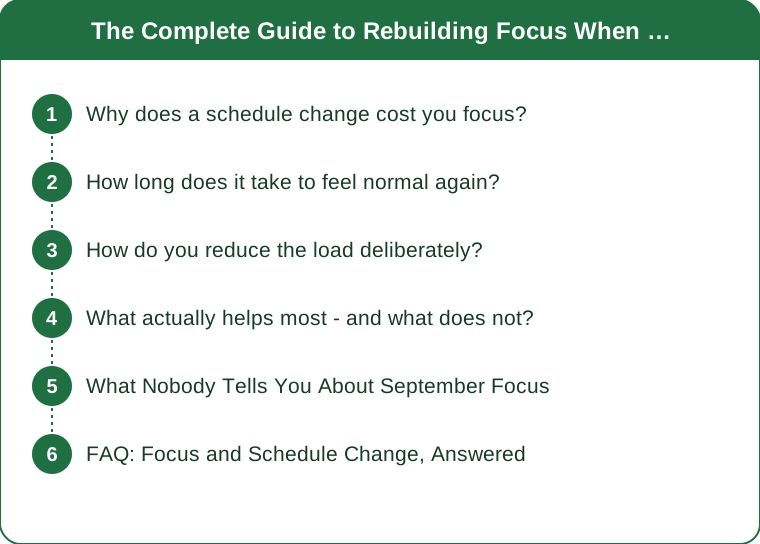
Why does a schedule change cost you focus?
Novel routines run in working memory; established ones run automatically. A route you have driven a hundred times requires almost nothing. A new one requires monitoring, decisions, and error-checking - and that capacity comes out of the same limited pool your actual work needs.
Working memory is genuinely limited. The capacity to hold and manipulate information in the moment is small and shared. Every unfamiliar sequence you are running - the new drop-off time, the new commute, the new meeting pattern - competes for it directly.
Change tends to arrive in clusters rather than singly. The September problem is not that one thing changed. It is that the school year, the office schedule, the daylight, the temperature, the social calendar, and often the family routine all changed within a fortnight of one another.
Each individual change looks trivially small, which is why people blame themselves. Nobody thinks leaving fifteen minutes earlier should affect their ability to concentrate, so when concentration drops they look for a cause in themselves rather than in the accumulation.
Sleep timing shifts underneath all of it. Earlier starts, darker mornings, and later evenings compress sleep from both ends. Even modest sleep restriction has well-documented effects on attention and working memory, and it is frequently the largest single contributor.
And interruption load usually rises at the same time. Returning to an office or a busier household means more unplanned interruptions, and recovering the thread after an interruption is itself costly - which is why a day with the same number of hours can produce far less output.
The reassuring part is that this is temporary by nature. Routines automate with repetition. The cost is front-loaded, and it declines as things become familiar - typically over a few weeks rather than a few days.
How long does it take to feel normal again?
Habit formation research suggests a wide range, commonly cited around two to three months on average with substantial individual variation. For simple routines it is much faster; for complex sequences involving other people, slower.
In practice, most people report a noticeable easing within three to six weeks. The first fortnight is the most expensive, and by week four most of the new sequences are running with far less conscious oversight.
Complexity matters more than count. A new routine that involves coordinating with other people - a school run, a shared commute, a childcare handover - automates more slowly than a solo one, because other people introduce variation that keeps it from becoming predictable.
Consistency accelerates it substantially. A routine performed at the same time in the same order every day automates far faster than one that varies. This is the strongest argument for keeping the new pattern rigid for a few weeks even if it is not optimal - you can optimize it once it is free to run.
Sleep timing takes its own time. Body clock shifts happen gradually, and pushing wake time an hour earlier is not absorbed in a night. Consistent wake times and morning light exposure are the two most effective levers here.
Expect a dip around week two or three specifically. The initial energy of a fresh start carries the first week, and the fatigue of running everything manually accumulates by the second or third - which is when people most often conclude something is wrong with them.
And be aware that a persistent problem is a different question. Focus difficulties that do not improve after a couple of months, or that pre-date the schedule change, deserve a different investigation - sleep disorders, thyroid function, iron deficiency, perimenopause, mood disorders, and ADHD are all worth discussing with a clinician rather than filing under seasonal adjustment. This is general information, not medical advice.
How do you reduce the load deliberately?
Stagger changes you control. If the school schedule, the office days, and the daylight all changed without your input, then this is not the fortnight to start a new training program, a course, or a diet. Delay every optional change by a month.
Automate the decisions rather than the actions. Deciding what to wear, what to eat, and what to do first are all working-memory expenses. Setting a default for each - a rotation, a standard breakfast, a fixed first task - is a large saving for a small cost.
Write the new routines down for the first two weeks. Externalizing a sequence onto paper removes it from working memory entirely. It feels excessive and it works, which is why checklists persist in every field where attention is expensive.
Protect one anchor that does not change. A single fixed point each day - the same walk, the same first hour, the same evening routine - gives everything else something to organize around, and the stability is disproportionately valuable while the rest is in flux.
Batch the interruptions rather than absorbing them. Two or three defined slots for messages and requests, rather than continuous availability, addresses the recovery cost of context switching directly.
Do the cognitively demanding work in your best window and defend it. For most people that is earlier in the day, and during a period of high routine load, one protected hour produces more than a scattered four.
And accept lower output for a fortnight rather than fighting it. Planning for a temporary dip means you finish the month having done the important things; refusing to acknowledge it usually means finishing the month exhausted and behind anyway.

What actually helps most - and what does not?
Fixing sleep timing helps most. A consistent wake time, morning daylight within an hour of waking, and a realistic bedtime address the largest single contributor. As mornings get darker over the coming weeks, getting outside early becomes both harder and more valuable.
Movement helps, and it does not need to be much. Physical activity has well-supported acute effects on attention and mood, and a short walk between demanding tasks is one of the most reliable resets available. Walking outdoors compounds it with daylight.
Reducing the number of open loops helps. Unfinished tasks occupy attention, so capturing everything into one trusted list - rather than holding it in your head - frees capacity directly.
Caffeine helps briefly and then complicates sleep. It is a reasonable tool early in the day and a poor solution to an afternoon slump caused by short sleep, since it can extend the problem into the night. Keeping it before early afternoon is a sensible default.
More screens do not help. The instinct to fill fragmented time with a phone raises the interruption load and provides no recovery, and it is the single most common way people spend the gaps that could restore attention.
Multitasking definitively does not help. Switching between tasks carries a real recovery cost every time, and during a period when working memory is already committed to running new routines, the cost is higher than usual.
Eating at regular times helps more than the specific food does. Irregular meals are common during a schedule change and they contribute to the afternoon dip people blame entirely on their workload. A protein-containing breakfast at a consistent time is a small intervention with a disproportionate effect on how the middle of the day feels.
And more caffeine, later nights, and harder self-criticism form a reliable downward loop. The most useful intervention available in a high-change month is frequently the least appealing one: go to bed earlier, do less, and let the routines become automatic on their own schedule.
What Nobody Tells You About September Focus
Nobody tells you that the fresh-start feeling is part of the trap. September carries genuine motivational energy, and people use it to add commitments precisely when their capacity to absorb new routines is already saturated.
Nobody tells you that other people’s changes cost you too. A partner’s new schedule, a child’s new school, a colleague’s new working pattern - each one adds coordination overhead to your week without appearing anywhere on your own list of changes.
Nobody tells you that the light shift is doing real work. Reduced morning light affects body clock timing, and the change over the next several weeks is substantial in most northern latitudes. Deliberate morning light exposure is a legitimate intervention rather than a wellness suggestion.
Nobody tells you that this is the wrong month to judge yourself. Performance during a high-change period is not representative, and decisions about your job, your capability, or your ambitions made in the middle of it are being made on bad data.
Nobody tells you the recovery is passive as much as active. Routines automate whether or not you work at it. Most of what you can do is avoid adding load and protect sleep while the automation happens.
And nobody tells you that writing down the changes is itself clarifying. People frequently discover they are running six new routines simultaneously and had counted only two - which immediately reframes the focus problem from a personal failing into an arithmetic one.
FAQ: Focus and Schedule Change, Answered
Why can I not concentrate in September?
Because several routines usually change at once, and new routines consume working memory until they become automatic. Add compressed sleep from earlier starts and darker mornings, plus a higher interruption load, and the capacity available for actual work drops sharply.
How long does it take to adjust to a new routine?
Habit research suggests a wide range averaging around two to three months, but most people notice a substantial easing within three to six weeks. Consistency accelerates it; routines that vary day to day automate much more slowly.
What is the single most useful thing to fix?
Sleep timing - a consistent wake time plus morning daylight within an hour of waking. It sits underneath attention, mood, and energy, and it is usually the largest single contributor during a schedule change.
Should I start new habits in September?
Generally not more than one. The fresh-start feeling is real but it arrives exactly when your capacity to absorb new routines is already committed. Delay optional changes by a month and the odds of them sticking improve considerably.
When is poor focus worth seeing a doctor about?
If it does not improve after a couple of months, pre-dates the schedule change, or comes with other symptoms. Sleep disorders, thyroid problems, iron deficiency, perimenopause, mood disorders, and ADHD are all worth discussing rather than assuming seasonal adjustment. This is general information, not medical advice.
TL;DR:
- New routines run in working memory and cost attention; established ones are nearly free - September’s problem is that several changed at once.
- Expect a noticeable easing in three to six weeks, with the worst dip around week two or three.
- Stagger every change you control, and delay optional new habits by a month.
- Automate decisions with defaults, write new sequences down for a fortnight, and protect one unchanging daily anchor.
- Fix sleep timing first - consistent wake time plus morning daylight - because it sits underneath everything else.
- Batch interruptions, defend one high-quality hour, and accept a temporary output dip rather than fighting it.
- Focus problems that persist beyond a couple of months or pre-date the change deserve a clinician’s assessment.
List the routines that changed. Most people find six where they counted two, and the focus problem stops looking like a personal failing. This is general information, not medical advice.
Keep Reading
This article is for general informational purposes only and is not medical advice. Always consult a qualified health professional for guidance specific to you.