Why a Walk Unsticks Your Brain When Staring at the Problem Does Not
Quick Answer: Walking reliably boosts divergent thinking - idea generation - with research showing large gains during and shortly after a walk, indoors or out. The mechanism is a mix of mild arousal, increased blood flow, and attention loosening its grip enough for background processing to surface. The dose is small: 10 to 20 minutes, easy pace. Load the problem before you leave, then stop forcing it - and bring a capture method, because the ideas arrive mid-stride.
Everyone has the story: forty minutes stuck at the desk, five minutes into a walk, solved. It gets told as a quirk. It is actually one of the more replicated tricks in cognitive research, and treating it as a tool instead of an accident is one of the cheapest upgrades a working brain can get.

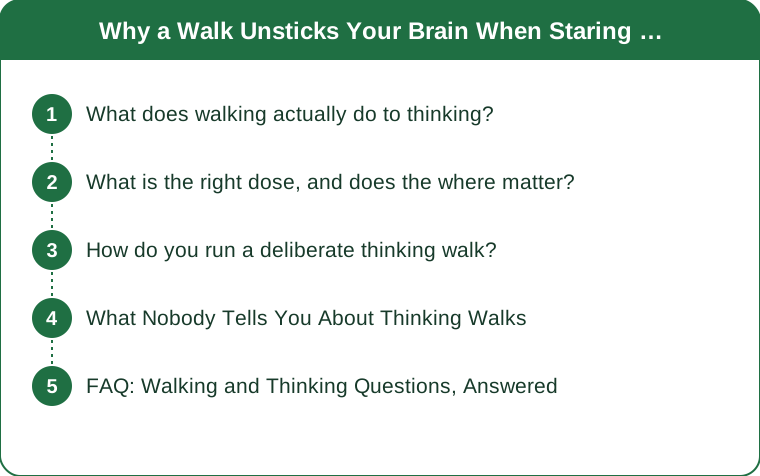
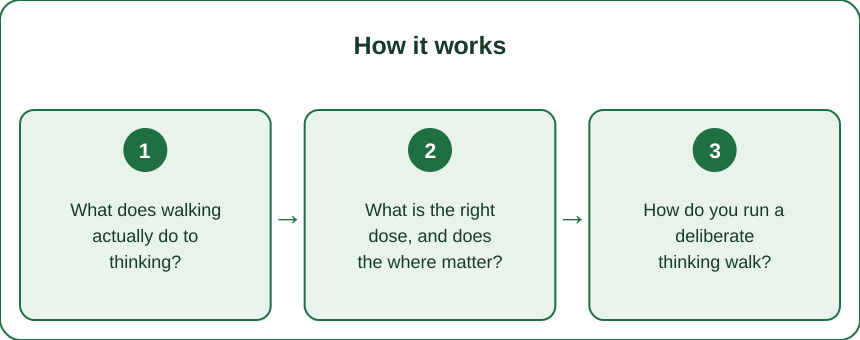
What does walking actually do to thinking?
Several small pushes in the same direction.
It raises the brain’s operating budget. Easy movement increases heart rate and cerebral blood flow modestly - arousal without stress. You are more alert than seated, less flooded than after intervals; a sweet spot for cognition.
It occupies the body’s supervision channel. Walking is automatic enough to need no thought but rhythmic enough to absorb the fidgety, self-monitoring layer of attention. With that layer busy, the tight spotlight of focus relaxes - and a relaxed spotlight is exactly what stuck problems need, because the fixation on the wrong approach loosens along with it.
It lets the background system speak. The mind-wandering mode - the network active when you are not gripping a task - is where remote associations get made, which is the raw material of both creativity and those shower-adjacent insights. Walking sits in the rare zone of enough stimulation to stay awake, little enough to let that mode run.
The best-known research, from Stanford, found people produced substantially more novel uses and ideas while walking than sitting - with the effect appearing even on a treadmill facing a blank wall, and lingering briefly after sitting back down. The scenery is a bonus. The walking itself is the ingredient.
What is the right dose, and does the where matter?
Duration: 10 to 20 minutes covers most of the effect. The research boosts show up fast - within minutes - and a stuck brain rarely needs an hour. If a problem survives a 20-minute walk, the answer is usually a second walk tomorrow, not a longer one today.
Pace: conversational, chosen by your legs. The benefit rides on ease and rhythm, not effort. A pace that has you monitoring your breathing has crossed into exercise, which is worth doing - but it is a different session with a different purpose. Let the legs pick, and let the pace drift.
Route: familiar and low-decision beats novel and interesting for problem-solving specifically. Navigation, traffic, and crowd-dodging all bill the same attention you are trying to free. The boring loop you could walk asleep is the high-performance option - one more reason the neighborhood circuit and the office-park loop deserve respect.
Outdoors adds its own layer - light, air, and the gentle attention-restoring quality of green things - and in late August the usable windows are the soft ones: morning before the heat builds, or the early-evening hour when a walk needs no negotiation. But the treadmill finding matters practically: a hallway, a parking structure, an airport concourse all work. Weather has no veto over the tool.
Frequency: as needed, like the tool it is - with one caveat. If every workday needs three rescue walks, the problem is upstream in how the desk hours are structured, and the walks are treating symptoms.

How do you run a deliberate thinking walk?
The difference between a walk that happens to help and a tool you can invoke is about ninety seconds of structure.
1. Load the question before you leave. Spend one minute stating the actual problem - ideally aloud or in one written sentence. Not the anxiety about the problem; the problem. What are we really deciding here? A loaded question gives the background system its assignment.
2. Then stop working on it. This is the counterintuitive step. Do not march along grinding the same loop you ground at the desk - that is the desk with scenery. Let attention drift to the sidewalk, the dog across the street, nothing. The drifting is the mechanism, and it feels unproductive for the first five minutes, which is precisely the phase where people give up and pull out their phone.
3. Capture without stopping the drift. Ideas surface mid-stride and evaporate within minutes. Voice memos beat typing - one sentence, phone back in pocket, keep walking. Two or three fragments is a spectacular haul.
4. Land it at the desk. The walk generates; the desk evaluates. Within ten minutes of returning, spend five turning fragments into one next action, or the whole loop dissolves into a pleasant memory.
And match the walk type to the work: problem walks get a loaded question; empty walks - no question, no input - are maintenance for the system itself, and the variety matters across a week.
What Nobody Tells You About Thinking Walks
The podcast is the tax. Filling every walk with input occupies the exact channel the effect runs on - you cannot receive the background system’s output while streaming someone else’s. Podcasts and calls have their place on maintenance miles, but a rescue walk for a stuck problem goes out with empty ears. The discomfort of the first quiet five minutes is withdrawal, and it passes.
Walking meetings work for exactly one format: two people, open-ended topic - brainstorming, a hard conversation, a career talk. Side-by-side beats face-to-face for candor, and the shared rhythm smooths disagreement. They fail for anything needing documents, decisions with details, or more than three people, which becomes a slow parade of people not hearing each other.
The effect is strongest for generating, not calculating. Walking helps you find options, angles, and phrasings; it does not help you check arithmetic or hold seven constraints in place - focused desk work wins there. Knowing which kind of stuck you are is half the skill.
And the insight has a short half-life. The mid-walk idea feels so vivid that recording it seems unnecessary. It is gone by the shower. The voice memo habit is not optional equipment; it is the difference between owning the tool and telling stories about it.
FAQ: Walking and Thinking Questions, Answered
How long should a walk be to boost thinking?
Ten to twenty minutes at an easy pace captures most of the effect - the research boosts appear within minutes and linger briefly afterward. Go longer for pleasure, not for more insight.
Does treadmill walking work or does it have to be outside?
The core creativity effect showed up on treadmills facing blank walls. Outdoors adds light, air, and mood benefits, but the walking itself is the active ingredient - weather is not an excuse the science honors.
Why do my best ideas come while walking and vanish after?
They surface from loose, associative processing that does not hand them to durable memory. Capture in the moment - a one-sentence voice memo - or accept the loss rate. There is no third option.
Should I listen to podcasts on a thinking walk?
Not on the walks meant to unstick a problem - input occupies the channel the answers arrive on. Save the audio for maintenance walks and commutes, and give the rescue walks silence.
TL;DR:
- Walking measurably boosts idea generation - during the walk and briefly after, indoors or out.
- Dose: 10 to 20 easy minutes on a boring route; the familiar loop is the high-performance option.
- Structure it: load one clear question, then drift; capture by voice memo; convert to a next action at the desk.
- Keep rescue walks input-free, use walking meetings only for open-ended one-on-ones, and know it aids generating, not calculating.
The desk is where finished thinking gets written down; a surprising share of the thinking itself happens at three miles an hour. Treat the walk as equipment, not escape, and stuck stops being a place you wait - it becomes a cue to put shoes on.
Keep Reading
This article is for general informational purposes only and is not medical advice. Always consult a qualified health professional for guidance specific to you.