Perimenopause Brain Fog: What's Actually Happening in Your Brain (and What Helps)
Quick Answer: Perimenopause brain fog is a real, hormonally-driven cognitive change, primarily linked to fluctuating and declining estrogen, which plays a direct role in memory and processing speed in the brain. It typically improves after the hormonal transition stabilizes post-menopause, and a combination of sleep, exercise, stress management, and sometimes medical treatment can meaningfully ease it in the meantime.
You walked into a room and forgot why, again, for the third time this week. You used to hold entire meeting agendas in your head, and now you’re writing sticky notes for tasks that used to be automatic. This isn’t you losing your edge — it’s a specific, well-documented hormonal shift happening in your brain right now.

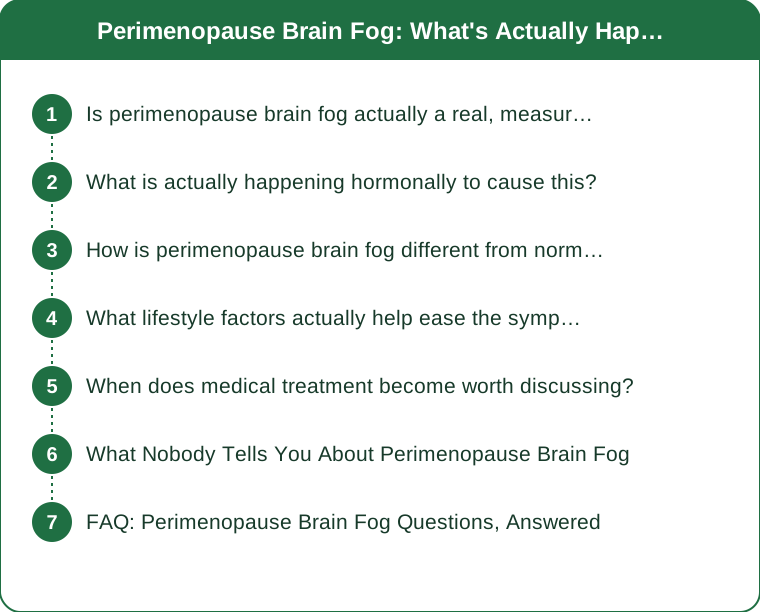
Is perimenopause brain fog actually a real, measurable phenomenon?
Yes — this isn’t just anecdotal. Multiple studies using cognitive testing during the menopause transition have documented measurable changes in verbal memory, processing speed, and attention during perimenopause compared to before it, particularly during the years immediately surrounding the final menstrual period. Researchers refer to this cluster of changes broadly as menopause-related cognitive changes, and it’s now a recognized, studied area of women’s health research rather than a dismissed complaint.
Importantly, most research suggests these changes are typically temporary, tied to the transition period itself, rather than a permanent decline — though the experience of it in the moment can feel disorienting and, for some women, genuinely worrying.
Some of the most commonly reported symptoms include walking into a room and forgetting why, losing a word mid-sentence that used to come easily, and needing to re-read the same paragraph or email several times before it sticks. None of these individually mean something is wrong; it’s the cluster and the timing, alongside other perimenopause symptoms, that points toward a hormonal explanation.
Interestingly, some research suggests the subjective experience of brain fog can feel more dramatic than what objective cognitive testing actually shows, meaning many women perform better on formal memory and processing tests than they expect based on how foggy they feel day to day. This gap between subjective experience and objective performance is itself a documented pattern, and understanding it can be reassuring even while the day-to-day frustration remains very real.
What is actually happening hormonally to cause this?
Estrogen plays a direct, active role in brain function, not just reproductive function — estrogen receptors are present throughout brain regions involved in memory, including the hippocampus, and estrogen influences neurotransmitter systems tied to attention and mood. As estrogen levels fluctuate unpredictably and then decline during perimenopause, these brain regions experience a genuine change in their hormonal environment, which can directly affect how memory and processing feel day to day.
This is compounded by the fact that perimenopause often coincides with sleep disruption (night sweats, insomnia) and increased life stress, both of which independently impair cognitive function — meaning the hormonal effect and lifestyle factors often stack on top of each other rather than acting alone.
Progesterone shifts play a role too, and some researchers point to changes in blood flow and glucose metabolism in the brain during this transition as additional contributing mechanisms. The full picture is still an active area of research, but the through-line across studies is consistent: this is a biological process with identifiable hormonal drivers, not a personal or character failing.
Brain imaging studies conducted during the menopause transition have also shown measurable changes in brain glucose metabolism patterns, which some researchers believe may relate to the brain temporarily adjusting its energy usage as estrogen’s supportive role shifts. This is offered less as a call to action and more as further evidence that what you’re feeling has a real, physical basis in the brain, not just a subjective sense that something feels different.
How is perimenopause brain fog different from normal aging or general forgetfulness?
Perimenopause brain fog tends to have a specific onset window, often starting in the mid-to-late 40s and clustering around irregular periods, hot flashes, and sleep disruption, rather than the slow, gradual pattern typical of general age-related cognitive change. It also frequently improves once hormone levels stabilize post-menopause, which distinguishes it from a progressive decline.
That said, distinguishing hormone-driven brain fog from other causes of memory change isn’t something to self-diagnose confidently — if symptoms are severe, rapidly worsening, or significantly disrupting daily function, a doctor’s evaluation is important to rule out other contributing causes.
Other conditions can produce similar symptoms and are worth ruling out alongside a perimenopause explanation, including thyroid changes, vitamin B12 or vitamin D deficiency, and mood conditions like depression or anxiety, which can all present with cognitive symptoms that overlap with hormonal brain fog. A thorough evaluation rather than an assumption in either direction serves you best.
A useful mental checklist before assuming it’s ‘just perimenopause’: is the change relatively recent and does it cluster with other perimenopause symptoms like irregular cycles, hot flashes, or sleep changes? Is it fluctuating rather than steadily progressive? Does it improve on better sleep or lower-stress weeks? Answering yes to these tends to support a hormonal explanation, while a steady, progressive pattern unrelated to these factors is more of a reason to seek evaluation sooner rather than later.

What lifestyle factors actually help ease the symptoms?
Sleep quality is one of the highest-leverage factors, since perimenopause frequently disrupts sleep through night sweats and hormonal shifts, and poor sleep independently worsens cognitive symptoms on top of the hormonal effect itself. Addressing sleep disruption directly — through temperature regulation, sleep hygiene, or medical treatment for night sweats — often improves brain fog symptoms noticeably.
Regular aerobic exercise has documented cognitive benefits during this life stage specifically, with some research suggesting it may help offset some of the hormonal cognitive effects. Stress management, adequate hydration, and a nutrient-dense diet round out the lifestyle factors most consistently linked to improved cognitive symptoms during this transition.
Practical daily strategies also help in the moment, even if they don’t address the underlying hormonal cause: writing things down immediately rather than trusting you’ll remember, breaking tasks into smaller written steps, and reducing multitasking during high-focus work all reduce the day-to-day friction brain fog creates, buying you some breathing room while the bigger lifestyle and possibly medical interventions take effect over weeks and months.
Nutrition specifically worth mentioning: stable blood sugar through regular, balanced meals rather than long gaps followed by large meals appears to support steadier cognitive function throughout the day, and staying well hydrated matters more than many people realize, since even mild dehydration is independently linked to reduced concentration and slower processing speed in research unrelated to menopause specifically.
When does medical treatment become worth discussing?
For some women, hormone therapy is a treatment option worth discussing with a doctor, particularly if brain fog is severe and accompanied by other significant perimenopause symptoms like hot flashes and sleep disruption. This is a personalized medical decision that depends on individual health history, risk factors, and symptom severity, not something to pursue without professional guidance.
Non-hormonal options, including certain medications for sleep or mood symptoms and targeted lifestyle interventions, are also reasonable to discuss, especially for women who aren’t candidates for hormone therapy or prefer not to pursue it.
A useful way to prepare for that conversation is tracking your symptoms for a few weeks beforehand — noting when brain fog feels worst relative to your cycle, sleep quality, and stress levels — since this pattern data helps your doctor distinguish a hormonal pattern from other possible causes and tailor treatment recommendations more precisely.
It’s also worth asking specifically about timing if hormone therapy is recommended, since some research suggests starting hormone therapy closer to the onset of menopause, rather than years later, may be associated with more favorable outcomes for some women — though this is a nuanced, individualized decision that depends heavily on personal health history and should be discussed thoroughly rather than generalized.
What Nobody Tells You About Perimenopause Brain Fog
Most women aren’t told that this is a named, studied phenomenon with a real hormonal mechanism until they’ve already spent months quietly worrying something is seriously wrong with their memory. Simply knowing that this pattern is common, temporary for most women, and hormonally explainable often reduces the anxiety layered on top of the cognitive symptoms themselves, which can be part of what’s making the experience feel worse.
It’s also rarely mentioned that brain fog can start years before periods actually stop, since perimenopause hormonal fluctuation often begins well before the more commonly recognized symptoms show up.
Another underdiscussed piece: workplace performance anxiety around brain fog is common and can create a stress feedback loop, where worrying about forgetting something actually makes it harder to focus and recall, on top of the hormonal effect itself. Naming that loop explicitly, and separating ‘the hormonal symptom’ from ‘the anxiety about the symptom,’ is something many women find genuinely helpful once they hear it framed that way.
Finally, it’s worth saying plainly: this is a temporary chapter for most women, not a permanent new normal. Talking with other women going through the same transition, whether friends, family, or a support community, often surfaces this same relief — that the fogginess, the lost words, the re-reading the same sentence three times, is a shared and explainable experience, not evidence that something in you has permanently changed for the worse.
FAQ: Perimenopause Brain Fog Questions, Answered
How long does perimenopause brain fog typically last?
It varies significantly, but for many women it improves after hormone levels stabilize post-menopause, meaning the most intense symptoms are often concentrated in the perimenopause transition itself rather than being permanent.
Should I be worried this is early dementia instead of perimenopause?
While it’s understandable to worry, perimenopause-related cognitive changes are common and distinct from dementia in pattern and progression — if you’re concerned, especially with a family history of early cognitive decline, discuss it directly with a doctor for proper evaluation.
Can supplements help with perimenopause brain fog?
Some supplements (like omega-3s) have general cognitive support research behind them, but evidence specifically for perimenopause brain fog is limited — discuss any supplement plan with a doctor rather than self-prescribing based on general claims.
Does brain fog affect all women during perimenopause, or just some?
Not every woman experiences noticeable cognitive symptoms during perimenopause — severity and presence vary widely, influenced by individual hormonal patterns, sleep quality, stress levels, and overall health.
TL;DR:
- Perimenopause brain fog is a real, measurable, hormonally-driven cognitive change, not imagined
- Fluctuating and declining estrogen directly affects brain regions tied to memory and attention
- Sleep disruption and stress often compound the hormonal effect, making both worth addressing
- Exercise, sleep hygiene, and in some cases hormone therapy can meaningfully ease symptoms
This is general information, not medical advice — talk with your doctor if brain fog is severe or worsening, to rule out other causes and discuss treatment options.
Keep Reading
This article is for general informational purposes only and is not medical advice. Always consult a qualified health professional for guidance specific to you.