Context Switching: Why an Eight-Hour Day Produces Two Hours of Work
Quick Answer: Every switch between tasks leaves attention residue - part of your mind stays on the previous task - and reorienting has a measurable cost. Research on interrupted work has found it commonly takes around 23 minutes to return to the original task, and studies of multitasking have found switch costs consuming a meaningful share of productive time. The fix is not willpower. It is fewer switches: batch by type, protect two 90-minute blocks, and remove the triggers that cause self-interruption.
The day is over and the honest accounting is uncomfortable. You were at your desk for eight hours, you were busy the entire time, and the one thing you meant to do is still not done. That is not a discipline failure and it is not, usually, a workload problem. It is an arithmetic problem, and the arithmetic is genuinely worse than most people assume.

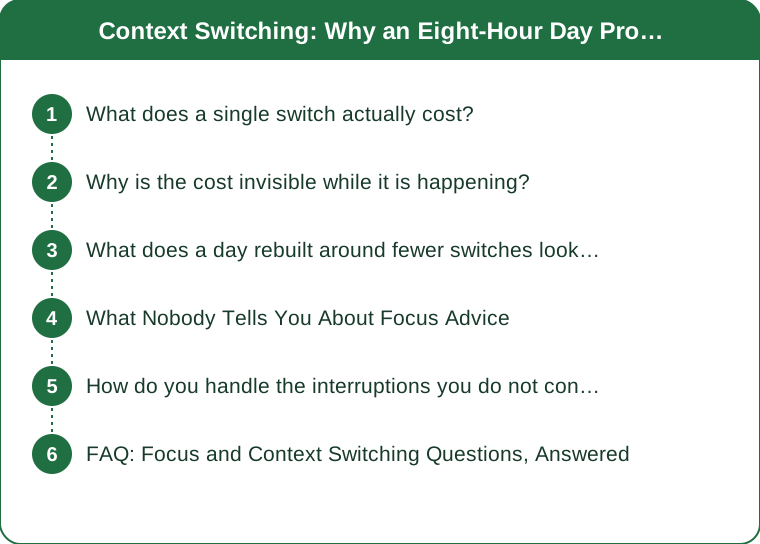
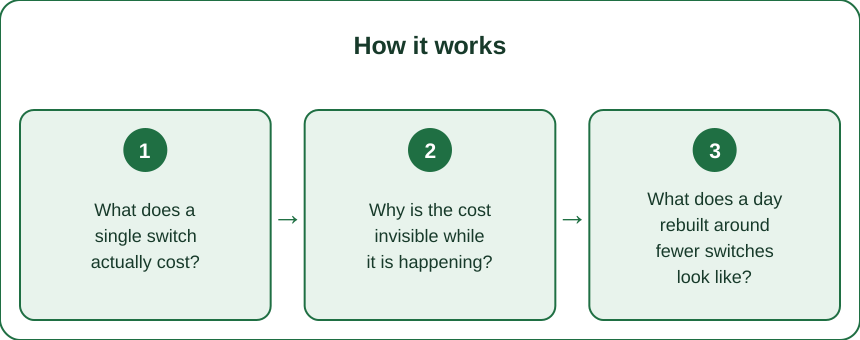
What does a single switch actually cost?
Two separate costs stack up, and only one of them is visible.
The visible cost is reorientation. When you return to a task, you have to rebuild the mental state you were in - what you were doing, why, what you had decided, where you were in the file. Research on interrupted knowledge work by Gloria Mark and colleagues found that people returned to an interrupted task after an average of around 23 minutes, having typically worked on two other things in between. That number gets quoted constantly, and it is worth being precise about what it means: not that a switch costs 23 minutes of concentration, but that the original task waits roughly that long to be resumed.
The invisible cost is attention residue. Work by Sophie Leroy describes what happens when you switch before a task is finished: part of your attention stays with the unfinished task, degrading performance on the new one. You are physically working on task B while some proportion of your cognitive capacity is still allocated to task A.
That second cost is why switching feels fine in the moment. There is no sensation of degraded performance. You simply do slightly worse work slightly more slowly, and there is no internal signal telling you so.
Stack twenty of those in a day and you have not lost twenty small moments. You have spent most of the day operating at partial capacity.
Why is the cost invisible while it is happening?
Three reasons, and understanding them is what makes the fixes stick.
Switching feels productive. Answering a message, clearing a notification, and replying to an email all produce a completion signal. That signal is rewarding, and it arrives far sooner than the reward from thirty minutes of hard thinking on a single problem. Your brain is comparing a certain small reward now against an uncertain larger reward later, and it is not a fair fight.
You cannot perceive your own degraded state. This is the same problem as sleep deprivation - performance falls faster than the perception of performance falling. You feel busy and engaged, so you conclude you are working well.
Most switches are self-initiated. This is the finding people find most uncomfortable. Studies of workplace interruption have consistently found that a large share of interruptions - often around half - come from the person themselves, not from anyone else. You open the browser tab. You check the phone during a slow paragraph. Blaming colleagues and notifications is comfortable and only half accurate.
The practical implication is that a workplace policy about notifications solves at most half the problem. The rest is a habit that has to be rebuilt at the level of what you do in the first three seconds of feeling stuck.
What does a day rebuilt around fewer switches look like?
The goal is not longer hours of concentration. It is fewer transitions between kinds of work.
Batch by cognitive type, not by project. Email is one type. Meetings are another. Deep creation is a third. Admin is a fourth. Doing three hours of mixed work costs more than doing an hour of each in sequence, because each type requires a different mental configuration.
A workable structure:
- Two 90-minute deep blocks, one in the morning and one after lunch, with everything closed. Ninety minutes is long enough to get past the 15-minute warm-up phase where the work still feels awkward.
- Two email and message windows, mid-morning and late afternoon. Not continuous availability.
- Meetings clustered into one part of the day rather than scattered. A meeting at 10am and another at 2pm destroys more of the day than four consecutive meetings do.
- An admin block at the low-energy point of the day, which for most people is early-to-mid afternoon.
Protect the first block above all others. Morning tends to be when concentration is most available, and it is also the block most frequently sacrificed to catching up on email - which reliably converts the best hours of the day into the least valuable work.

What Nobody Tells You About Focus Advice
Most focus advice targets the wrong layer. Apps that block websites address the symptom at the moment of temptation, which is the hardest possible point to intervene. Restructuring the day so there is nothing to switch to for 90 minutes addresses it before the temptation forms.
The three-second rule matters more than any tool. The moment a task gets hard is when the urge to switch arrives, and it arrives fast. Deciding in advance what you do in that moment - write the next sentence badly, or note the blocker on paper and continue - is worth more than any amount of general resolve.
Attention residue means finishing matters. Where you can, get to a natural completion point before switching. If you cannot, spend 30 seconds writing down exactly where you are and what the next action is. That note is what lets you close the loop mentally, and it substantially reduces the residue you carry into the next task.
Open loops are expensive even when you are not working on them. A dozen unfinished threads generate low-level background load all day. Deliberately closing or explicitly parking them - in writing, somewhere you trust - frees capacity.
And some days are legitimately fragmented. A day full of meetings and interruptions is not a day to attempt deep work in the gaps. Use it for the work that survives interruption - admin, correspondence, planning - and protect a different day for the hard thinking. Trying to write something difficult in three ten-minute gaps produces neither the writing nor the rest.
How do you handle the interruptions you do not control?
Some interruptions are the job. The aim is to shape them rather than to eliminate them.
Make your availability legible. A shared calendar block labelled as focused work, a status that says when you will next respond, or a simple stated norm - I check messages at 11 and 4 - resets expectations far more effectively than being quietly unavailable. Most people are entirely reasonable when told; they are not mind readers.
Negotiate the response-time expectation, not the interruption itself. Very little genuinely requires a response in under an hour. Almost everything is treated as though it does, because nobody ever said otherwise.
Use a capture list. When someone interrupts with something that is not urgent, write it down rather than doing it. This is the single highest-leverage habit here: it converts an interruption into a queued item at a cost of about eight seconds.
Batch your own outgoing interruptions too. If you send four separate messages to a colleague across a morning, you have caused four switches for them, and they will do the same to you. Teams that batch communication get more back than they give up.
And build in real transitions. A two-minute gap between a meeting and deep work - stand up, look out of a window, write the first line of the next task - measurably reduces the residue you carry in. Back-to-back scheduling with no gaps guarantees you arrive at every task carrying the last one.
FAQ: Focus and Context Switching Questions, Answered
How long does it take to refocus after an interruption?
Research on knowledge work found people took an average of roughly 23 minutes to return to the interrupted task, typically working on two other things in between. The full return to the same depth of engagement can take longer.
Is multitasking really that bad?
For tasks requiring thought, yes - what feels like multitasking is rapid switching, and each switch carries a cost plus attention residue. For genuinely automatic tasks, like walking and talking, it is fine.
What is attention residue?
The portion of your attention that stays with a previous task after you switch, particularly when that task was left unfinished. It degrades performance on the new task without producing any sensation that anything is wrong.
How long should a deep work block be?
Ninety minutes suits most people - long enough to get past the awkward warm-up phase, short enough to sustain. Two such blocks in a day is a genuinely productive day by any reasonable standard.
TL;DR:
- Each switch costs reorientation time plus attention residue, and only the first is visible to you.
- Around half of interruptions are self-initiated, so notification policies solve at most half the problem.
- Batch by cognitive type, protect two 90-minute blocks, and cluster meetings rather than scattering them.
- Before switching, spend 30 seconds writing where you are - it is the cheapest fix available.
The day does not need more hours or more discipline. It needs fewer transitions, and almost every transition in a normal day is one somebody chose - which means it is one somebody can un-choose.
Keep Reading
This article is for general informational purposes only and is not medical advice. Always consult a qualified health professional for guidance specific to you.