The Complete Guide to Exercise and Brain Function: What the Evidence Supports
Quick Answer: Aerobic exercise has the strongest evidence for cognitive benefit, with effects most consistently observed for executive function - planning, attention, and task-switching - rather than for general intelligence or memory in isolation. The mechanisms involve increased blood flow, growth factors including BDNF, and effects on sleep and mood. Meaningful benefit appears at around 150 minutes weekly of moderate aerobic activity, with resistance training adding independent value.
The research on exercise and cognition is genuinely strong in places and considerably weaker in others, and popular coverage tends to flatten that distinction. This is a long piece because the useful information is in the details.

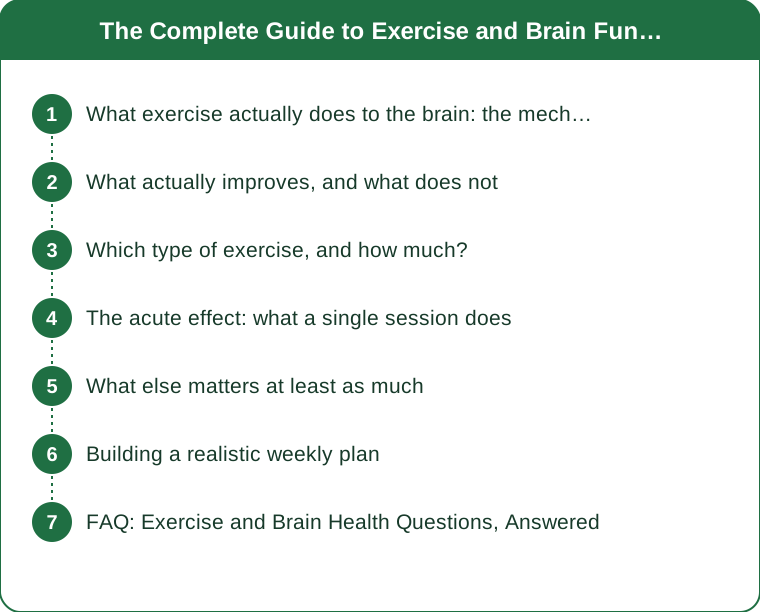
What exercise actually does to the brain: the mechanisms
Several distinct pathways are involved, and understanding them explains why dosing and modality matter.
Cerebral blood flow increases both acutely and chronically. During aerobic exercise, blood flow to the brain rises. Over months of training, vascular adaptations appear to improve perfusion at rest as well. Since neurons depend entirely on continuous delivery of oxygen and glucose, this is not a trivial change.
BDNF - brain-derived neurotrophic factor - rises with exercise. BDNF supports the survival of existing neurons and the growth of new connections. Aerobic exercise reliably increases circulating BDNF, and this is one of the most cited mechanisms in the field.
An important caveat about BDNF: most of the mechanistic detail comes from animal research, where the brain can be examined directly. Human studies measure blood BDNF, which is an indirect proxy for what is happening in brain tissue. The mechanism is plausible and well-supported; the popular framing of BDNF as a simple dial you turn up with exercise overstates the precision of what is known.
Hippocampal volume. The hippocampus is central to memory formation and shrinks with age. Several trials of aerobic exercise in older adults have found increases in hippocampal volume relative to control groups, which is a striking finding given that the default trajectory is decline.
Neurotransmitter systems. Exercise affects dopamine, serotonin, and noradrenaline signalling, which plausibly accounts for much of the acute effect on mood, alertness, and focus in the hours after a session.
Inflammation and metabolic health. Chronic low-grade inflammation and insulin resistance are both associated with cognitive decline. Exercise improves both, which may be a substantial part of the long-term benefit and is often left out of the more excitable coverage.
Sleep. Regular exercise improves sleep quality for most people, and sleep is when memory consolidation occurs. Some of what looks like a direct exercise-to-memory effect is very likely mediated through better sleep - which makes it no less real, just differently explained.
What actually improves, and what does not
This is where popular coverage most often overreaches, and where being precise is genuinely useful.
Executive function shows the most consistent benefit. This covers planning, working memory, inhibitory control, cognitive flexibility, and task-switching. Meta-analyses of exercise interventions find effects here more reliably than in other domains.
Why executive function specifically: it depends heavily on the prefrontal cortex, which is metabolically demanding, sensitive to blood flow, and among the first regions affected by ageing and vascular health. It is also the domain most affected by sleep and mood, both of which exercise improves.
Processing speed shows benefit in a number of studies, particularly in older adults.
Memory shows more mixed results. Some studies find improvement, particularly in older adults and particularly for spatial memory. Others find little. The hippocampal volume findings are encouraging but do not translate straightforwardly into measurable memory improvement in every trial.
What does not change: general intelligence. Exercise does not raise IQ. Claims to the contrary conflate improved performance on cognitive tests - which can reflect better attention and faster processing - with a change in underlying capacity.
Effect sizes are typically modest. This matters. Exercise produces real, measurable, replicated cognitive benefits, and those benefits are generally small to moderate rather than transformative. Anyone describing exercise as dramatically enhancing cognition is exceeding what the evidence shows.
Who benefits most: effects tend to be larger in older adults, in people starting from low fitness, and in those with existing cognitive concerns. A fit 30-year-old adding a fourth weekly session should expect less than a sedentary 65-year-old starting their first.
The strongest practical finding may be the long-term one: physical activity across midlife is consistently associated with lower risk of cognitive decline and dementia in later life. That is observational evidence with its own limitations, but it is consistent across many large studies.
Which type of exercise, and how much?
Aerobic exercise has the strongest and most replicated evidence. Walking, cycling, swimming, running - anything that raises heart rate and sustains it.
The dose that appears in most of the useful research: around 150 minutes weekly of moderate-intensity aerobic activity, typically in sessions of 30-45 minutes, three to five times weekly. This is the same figure as general health guidance, which is convenient rather than coincidental - the cardiovascular and cerebrovascular systems are the same system.
Intensity: moderate means you can talk but not sing. Vigorous exercise may produce somewhat larger effects in some studies, but adherence matters more than optimisation, and moderate is what people sustain.
Resistance training has independent value and has been under-studied relative to aerobic work. Trials of resistance training in older adults have found cognitive benefits, particularly for executive function. The mechanisms may differ - growth factors, metabolic health, and effects on sleep among them.
Two resistance sessions weekly is a reasonable target alongside aerobic work, and the combination appears more effective than either alone.
Coordination-demanding activity may add something further. Dance, racquet sports, and martial arts combine aerobic demand with motor learning and, often, social interaction. Studies of dance in older adults have produced some of the more notable findings in the field, though disentangling the exercise from the learning and the socialising is difficult.
Yoga and mind-body practices show benefits that appear to run substantially through stress reduction and sleep improvement rather than through cardiovascular adaptation. That does not make them less useful - it makes them a different tool.
Consistency dominates everything. Twelve weeks is roughly the minimum duration at which most trials detect change, and the benefits reverse when training stops. There is no accumulating credit.

The acute effect: what a single session does
Separate from long-term adaptation, one session of exercise produces measurable short-term cognitive effects, and this is the most immediately usable finding in the entire field.
The window is roughly two hours. Following moderate aerobic exercise, attention, processing speed, and executive function typically show measurable improvement, with effects generally strongest in the first hour or two.
The practical application is obvious and underused: put your most cognitively demanding work immediately after exercise rather than before it. A 30-minute walk before a difficult task uses the acute window, and it is free.
Intensity has an inverted relationship with the acute effect. Moderate exercise reliably improves subsequent cognitive performance. Very intense or exhausting exercise can temporarily impair it, because fatigue competes with the benefit. A hard interval session is not the ideal precursor to demanding mental work.
Duration: the acute effect appears with sessions as short as 10-20 minutes. This is one of the rare cases where a genuinely small intervention produces a measurable result.
Walking outdoors may add something. Research on attention restoration in natural environments suggests time in green space independently supports directed attention, over and above the exercise itself. A walk in a park and the same walk on a treadmill are probably not equivalent, though the size of that difference is debated.
The afternoon dip is the obvious target. Most people experience a genuine drop in alertness in the early afternoon. A 15-minute brisk walk at that point is a better-evidenced intervention than a third coffee, and it does not affect that night’s sleep.
Timing relative to sleep: vigorous exercise very close to bedtime disrupts sleep for some people and not others. Given how central sleep is to the cognitive benefits, this is worth testing on yourself rather than assuming.
What else matters at least as much
Exercise is one input among several, and presenting it in isolation gives a distorted picture of what actually determines cognitive function.
Sleep is probably the largest single factor. Memory consolidation occurs during sleep, and the clearance of metabolic waste from brain tissue appears to be enhanced during sleep. A week of poor sleep degrades cognitive performance more than a week of missed training, and no amount of exercise compensates for chronic sleep restriction.
This has a direct implication: if you are choosing between an early workout and an extra hour of sleep when you are already sleep-deprived, the sleep is very likely the better choice for cognition.
Cardiovascular and metabolic health. Hypertension, type 2 diabetes, and high cholesterol in midlife are all associated with increased risk of later cognitive decline. Exercise helps with all three, and so do the other things that help with all three.
Social connection is consistently associated with better cognitive outcomes in older adults, and social isolation with worse. This may be part of why group-based and partner exercise shows well in studies.
Cognitive engagement. Learning genuinely new things - a language, an instrument, a complex skill - appears to contribute independently. Brain-training apps have a considerably weaker evidence base and largely show improvement at the trained task rather than transfer to anything else.
Hearing. Untreated hearing loss is one of the more significant modifiable risk factors identified for dementia, and it receives a fraction of the attention that exercise does. Getting hearing checked is a genuinely high-value action.
Alcohol and smoking both affect brain health negatively, and reducing either is likely to matter more than optimising a training programme.
The honest framing: exercise belongs in a cluster of factors that collectively matter a great deal. Treating it as the single lever - which is how it is usually presented - both overstates its individual effect and lets the other factors go unaddressed.
Building a realistic weekly plan
What the evidence above assembles into, for someone without contraindications.
The aerobic base: 150 minutes weekly, moderate intensity. In practice, five 30-minute brisk walks, three 50-minute sessions, or any combination that reaches the total. Splitting it into shorter bouts appears to work - the total matters more than session length.
Resistance training: two sessions weekly. Full-body, compound movements, progressive load. This has independent cognitive value plus everything else it does.
One coordination-demanding activity if you enjoy one. Dance, tennis, badminton, a martial art. Optional, plausibly additive, and much more likely to be sustained because it is enjoyable.
The acute-effect placement: schedule your most demanding cognitive work after a session rather than before. If you work from home, a 20-minute walk before a difficult morning block is the highest-return scheduling change available.
The afternoon walk: 15 minutes, outdoors, around the time your focus drops. Cheap, effective, and it improves that night’s sleep too.
What to prioritise if you can only do one thing: daily brisk walking. It has the broadest evidence base, the lowest barrier, requires nothing, and can be built into an existing routine rather than added to it.
Realistic expectations: better focus and mood in the hours after sessions, noticeable within days. Measurable cognitive change on formal testing, twelve weeks minimum. Long-term risk reduction, decades. The first of these is what sustains the habit, so it is worth paying attention to.
Autumn note: darker mornings reduce outdoor activity for many people, and this is the point in the year when established routines lapse. Moving the walk to lunchtime rather than trying to preserve a pre-dawn one is the adjustment that survives the season.
FAQ: Exercise and Brain Health Questions, Answered
How quickly would I notice anything?
Acute effects on focus and mood appear the same day. Measurable change on cognitive testing typically requires around twelve weeks of consistent training.
Is walking really enough, or do I need to run?
Walking at a genuinely brisk pace appears in a great deal of the supporting research and produces meaningful benefit. Higher intensity may add somewhat more, but adherence matters more than intensity.
Do brain-training apps work?
They reliably improve performance at the trained task. Evidence for transfer to general cognitive ability or everyday function is weak. Exercise has considerably better evidence for the outcomes people actually care about.
Can exercise prevent dementia?
Physical activity is consistently associated with reduced risk in large observational studies, and it is identified as a modifiable risk factor. Reduced risk is not prevention, and no single behaviour guarantees an outcome. This is general information, not medical advice.
Is it too late to start in my seventies?
No. Some of the most notable findings - including hippocampal volume increases - come from trials in older adults. Effect sizes are often larger in people starting from lower fitness.
Does exercising more than 150 minutes give proportionally more benefit?
Benefits appear to increase with more activity but with diminishing returns, and very high volumes have not shown proportional cognitive gains. Consistency at a moderate dose outperforms sporadic large efforts.
TL;DR:
- Executive function - planning, attention, task-switching - shows the most consistent benefit; general intelligence does not change
- Mechanisms include cerebral blood flow, BDNF, metabolic health, and improved sleep, with the sleep pathway probably underrated
- Around 150 minutes weekly of moderate aerobic activity plus two resistance sessions is the well-supported dose
- A single session improves focus for roughly two hours - schedule demanding work right after exercise
- Effect sizes are modest but real; sleep, hearing, and cardiovascular health matter at least as much
- Twelve weeks minimum before measurable change, and benefits reverse when training stops
If you do one thing: brisk daily walking, moved to lunchtime as the mornings get darker. This is general information, not medical advice.
Keep Reading
This article is for general informational purposes only and is not medical advice. Always consult a qualified health professional for guidance specific to you.