Why Your Brain Needs Longer to Recover From Multitasking Than You Think
Quick Answer: Switching between tasks creates measurable “switch costs” that persist well after the multitasking session ends, with research suggesting cognitive recovery from sustained task-switching can take anywhere from 20 minutes to several hours depending on the intensity and duration of the multitasking involved — far longer than the popular assumption that closing a tab or ending a call resets the brain instantly.
The common mental model of multitasking recovery is that it works like a light switch: stop juggling tasks, and your focus snaps right back. The actual cognitive science paints a considerably slower, messier picture.

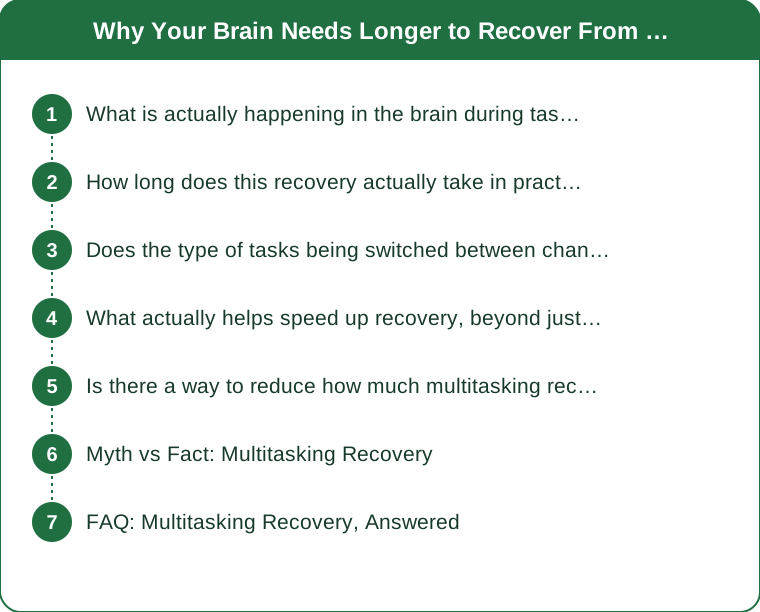
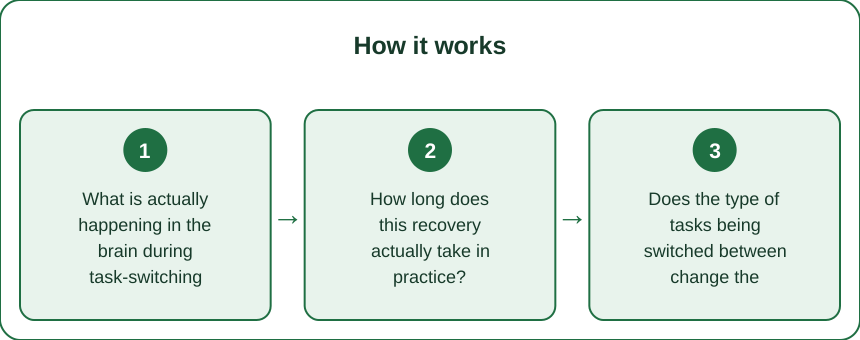
What is actually happening in the brain during task-switching that creates this lingering cost?
Each time attention shifts between tasks, the brain has to disengage the rule set and context for the previous task and load a new one — a process researchers call “attention residue,” where part of your cognitive resources remain tied up processing the previous task even after you’ve nominally moved on. This isn’t a willpower failure; it’s a structural property of how attention systems in the brain function, and it means the mental cost of switching outlasts the switch itself.
The more emotionally engaging or unfinished the previous task felt, the stronger this residue effect tends to be — which is part of why switching away from a stressful, unresolved email thread leaves a stronger lingering distraction than switching away from a task you’d already mentally completed.
How long does this recovery actually take in practice?
Studies on task-switching costs generally find measurable performance decrements (slower reaction time, more errors) persisting for at least 20-30 minutes after a switch in lighter multitasking scenarios, but for sustained heavy multitasking — several hours of rapid switching between demanding tasks — subjective and measured mental fatigue can persist for the remainder of the day, requiring a longer, more deliberate recovery period rather than a short break.
This variability is exactly why generic advice like “take a 5-minute break” sometimes works and sometimes doesn’t — the appropriate recovery period scales with how demanding and how prolonged the multitasking session actually was, not a fixed universal number.
Does the type of tasks being switched between change the recovery time?
Switching between tasks that use similar cognitive resources (two different writing tasks, for example) tends to create less residue than switching between very different types of tasks (analytical work followed immediately by an emotionally charged conversation), because dissimilar tasks require more complete reconfiguration of mental context. This is one reason why a full day of back-to-back, varied meetings often feels more mentally draining than a day of similar focused work blocks, even if the total hours are the same.
Understanding this can help with scheduling — grouping similar types of tasks together, rather than alternating constantly between very different cognitive modes, reduces the cumulative switch-cost burden across a day.

What actually helps speed up recovery, beyond just waiting it out?
Deliberate closure — briefly writing down where you left off on the previous task before switching — appears to reduce attention residue meaningfully in research on this topic, likely because it gives the brain a clear stopping point rather than leaving the task cognitively “open.” Short physical movement breaks (a walk, stretching) also show measurable benefit for restoring attentional capacity faster than simply sitting and resting.
Caffeine and light exposure can mask fatigue subjectively without actually resolving the underlying attention residue, which is worth being aware of — feeling more alert isn’t the same as having genuinely recovered cognitive capacity, and this gap can lead to continued errors even when someone feels ready to refocus.
Is there a way to reduce how much multitasking recovery debt builds up in the first place?
Batching similar tasks into blocks and using dedicated, uninterrupted time for demanding work — sometimes called timeboxing — reduces the total number of switches in a day, which is the more effective long-term strategy compared to simply getting faster at recovering from each individual switch. Turning off non-urgent notifications during focused blocks specifically prevents the kind of unplanned, frequent switching that accumulates the most recovery debt over a workday.
This approach requires some upfront planning — grouping similar meetings, blocking out focus time in a calendar — but the research on attention residue suggests this structural prevention is considerably more effective than any single technique for recovering faster after the fact.
Myth vs Fact: Multitasking Recovery
Myth: Closing a task or ending a call resets your focus immediately. Fact: Attention residue from the previous task lingers measurably, often for 20+ minutes even after light task-switching.
Myth: Feeling alert after caffeine means your cognitive recovery is complete. Fact: Caffeine can mask subjective fatigue without resolving the underlying attention residue, meaning error rates can stay elevated even when you feel ready.
FAQ: Multitasking Recovery, Answered
Does writing down where I left off really help that much?
Research on this specific technique suggests a meaningful reduction in attention residue, likely because it gives the brain a clear, externalized stopping point rather than an unresolved mental loop.
Is some multitasking recovery debt unavoidable in a normal workday?
Yes, complete elimination isn’t realistic for most jobs — the goal is reducing unnecessary switching through batching and notification management, not eliminating all task variety.
Does this recovery time get faster with practice or experience?
There’s some evidence that people develop better task-switching strategies with practice, but the fundamental attention residue effect appears to persist even in experienced multitaskers, just sometimes with slightly faster recovery.
TL;DR:
- Task-switching creates “attention residue” that lingers well after the switch itself, often 20+ minutes
- Recovery time scales with how demanding and prolonged the multitasking session was
- Switching between very different task types creates more residue than switching between similar ones
- Writing down a stopping point and taking movement breaks help more than caffeine or willpower alone
- Batching similar tasks and blocking focus time reduces how much recovery debt builds up in the first place
Understanding multitasking recovery as a real cognitive cost, not just a mental habit to push through, makes it easier to structure a workday that actually protects focus.
Keep Reading
This article is for general informational purposes only and is not medical advice. Always consult a qualified health professional for guidance specific to you.