What Actually Happens in Your Brain When You Learn a New Language After 40
Quick Answer: Learning a new language after 40 is genuinely harder for pronunciation and rapid recall than it was in childhood, but research links sustained language learning in adulthood to measurable improvements in executive function and a delayed onset of age-related cognitive decline — the struggle itself may be part of what makes it beneficial.
The common narrative is that language learning has a hard ceiling after childhood, but the cognitive science tells a more interesting story — the difficulty adults experience learning a new language is doing real, measurable work in the brain.

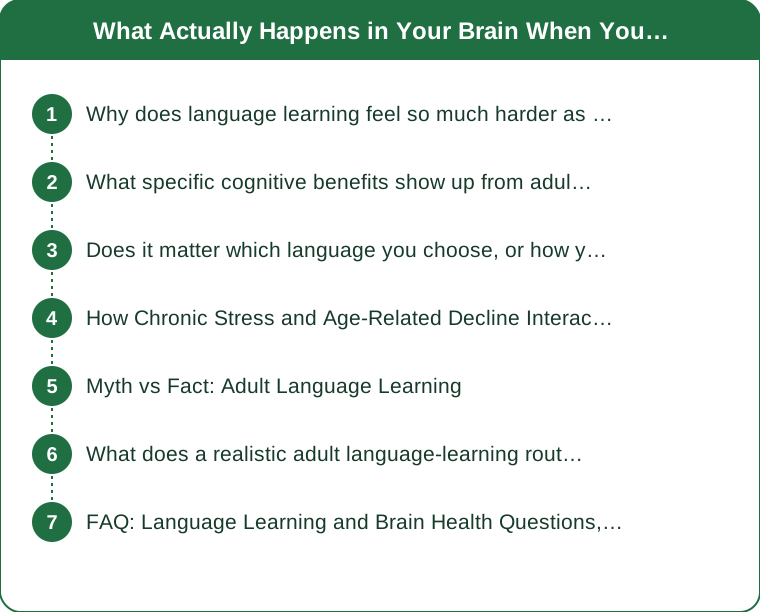
Why does language learning feel so much harder as an adult?
Children’s brains have more neuroplasticity during a sensitive period for language acquisition roughly through puberty, allowing near-effortless absorption of grammar and pronunciation patterns. Adult brains have already built strong, efficient neural pathways for a first language, and new language learning has to work around and integrate with those existing pathways rather than building from a blank slate — which is genuinely more effortful, not a sign of reduced capability.
This difference explains the accent gap (adults rarely achieve a fully native accent) without meaning adults can’t achieve genuine fluency and strong cognitive benefit from the process.
What specific cognitive benefits show up from adult language learning?
Research on bilingualism and language learning points to improvements in executive function — specifically task-switching, working memory, and inhibitory control (the ability to suppress an irrelevant response, like a word in the wrong language, in favor of the correct one). This inhibitory control training happens every time a language learner must suppress default-language vocabulary in favor of the new language, functioning as a kind of ongoing mental exercise distinct from vocabulary memorization itself.
Several studies on bilingual populations have also found a later average age of onset for dementia symptoms compared to monolingual populations, though this research area continues to develop and isn’t a guarantee for any individual.
Does it matter which language you choose, or how you study, for these benefits?
The specific language matters less than the consistency and depth of engagement — research generally credits the effortful, sustained cognitive work of active language learning (not passive exposure like background audio) with the observed benefits. Structured methods requiring active recall (flashcard-style practice, conversation practice, writing exercises) appear more beneficial than passive listening alone, because active recall is what engages the working memory and inhibitory control systems most directly.
This means a rigorous, consistent practice in one language likely offers more cognitive benefit than dabbling lightly across several languages without real depth in any of them.

How Chronic Stress and Age-Related Decline Interact with Learning Motivation
Adults learning a new language after 40 often face an additional obstacle: self-consciousness about making mistakes in front of others, which younger learners and children experience far less acutely. This social hesitancy can reduce the frequency of active speaking practice — arguably the most cognitively beneficial part of language learning — more than any actual cognitive limitation does. Framing mistakes as an expected, necessary part of the process (rather than a reflection of capability) removes a barrier that has little to do with the brain’s actual learning capacity and everything to do with self-consciousness.
Myth vs Fact: Adult Language Learning
Myth: There’s a hard age cutoff after which language learning cognitive benefits disappear. Fact: Research shows measurable cognitive benefits from sustained language learning well into older adulthood, though the pace and eventual fluency ceiling differ from childhood learning.
Myth: Passive exposure (subtitles, background podcasts) provides the same benefit as active study. Fact: Active recall and production (speaking, writing) engage the executive function systems linked to cognitive benefit far more than passive listening alone.
Myth: If you don’t achieve near-native fluency, the effort wasn’t cognitively worthwhile. Fact: Research on cognitive benefit is linked to the process of sustained active learning itself, not to achieving a specific fluency threshold.
What does a realistic adult language-learning routine look like for cognitive benefit?
Most research-informed recommendations suggest short, frequent, active practice sessions (15-30 minutes, most days of the week) over occasional long study sessions, since consistency and frequency of active recall matter more than session length. Combining structured study (grammar, vocabulary) with actual conversation practice — even briefly, with a language partner or tutor — appears to provide more rounded benefit than vocabulary memorization alone, since conversation demands real-time inhibitory control and retrieval under time pressure.
FAQ: Language Learning and Brain Health Questions, Answered
Is it ever too late to start learning a new language for cognitive benefit?
Research doesn’t identify a hard cutoff age — studies have found cognitive engagement benefits in language learners starting well into their 60s and 70s.
Do language learning apps provide the same benefit as a class or tutor?
Apps with active recall features (not just passive review) provide meaningful benefit, though conversation practice with another person adds a real-time processing element apps typically can’t replicate.
How soon might I notice any cognitive benefit from language learning?
Some studies suggest measurable executive function improvements within a few months of consistent, active practice, though individual variation is significant and effects likely build gradually with continued practice.
TL;DR:
- Adult brains learn language differently than children’s, working around already-established pathways — this is why it feels harder, not a sign of reduced capability
- Research links sustained language learning to improved executive function and possibly delayed cognitive decline onset
- Active recall (speaking, writing) drives more cognitive benefit than passive listening alone
- Consistency (short, frequent sessions) matters more than occasional long study blocks
If you’ve been putting off language learning because it feels too hard at this age, the difficulty itself is part of what may be making it cognitively worthwhile. This is general information, not medical advice.
Keep Reading
This article is for general informational purposes only and is not medical advice. Always consult a qualified health professional for guidance specific to you.