How Chronic Stress Quietly Rewires Focus and Memory — and the Complete Plan to Reverse It
Quick Answer: Chronic stress elevates cortisol in ways that can shrink the hippocampus (memory) and impair prefrontal cortex function (focus and decision-making) over months of sustained exposure — but this process is measurably reversible once stress hormone patterns normalize, through a combination of sleep, targeted exercise, and stress-response training.
“Brain fog” gets treated like a vague complaint, something to push through with more coffee. The reality is more specific and, honestly, more useful to know: sustained stress hormone exposure changes brain structure and function in identifiable ways, and reversing it takes a deliberate, multi-part approach rather than just “relaxing more.”

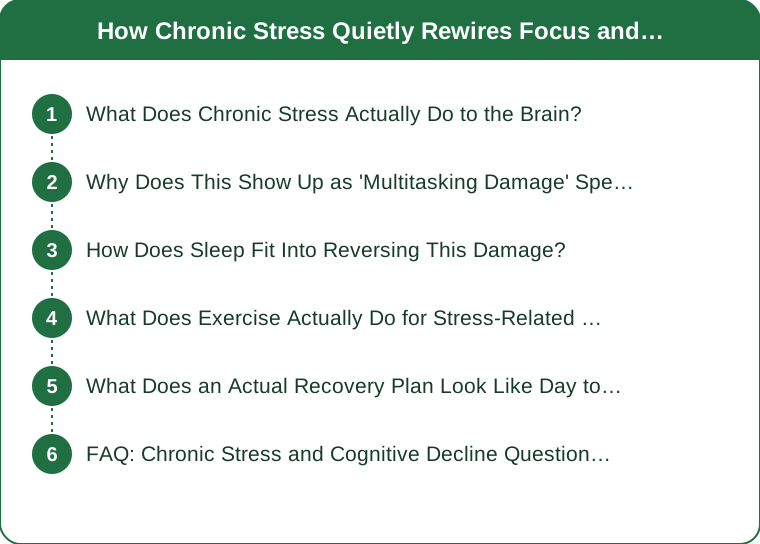
What Does Chronic Stress Actually Do to the Brain?
Cortisol, the primary stress hormone, is useful in short bursts — it sharpens focus during an acute deadline or threat. The problem is duration: when cortisol stays elevated for weeks or months rather than hours, it starts working against the systems it initially helped.
Research on chronic stress consistently shows measurable effects on the hippocampus, the brain region central to forming new memories, including reduced volume with sustained high cortisol exposure. The prefrontal cortex — responsible for focus, planning, and impulse control — also shows reduced connectivity and activity under chronic stress conditions, which explains why simple decisions start feeling exhausting during a prolonged stressful period.
Importantly, this isn’t a fixed or permanent state. Neuroplasticity research shows the brain retains the capacity to rebuild these connections once the underlying stress load decreases, which is the encouraging half of this picture that often gets left out.
Why Does This Show Up as ‘Multitasking Damage’ Specifically?
Attempting to juggle multiple demands under chronic stress compounds the problem beyond stress alone. Task-switching itself has a measurable cognitive cost — each switch requires the brain to disengage one set of rules and engage another, and this cost is amplified when baseline cognitive resources are already depleted by elevated cortisol.
People under chronic stress who also multitask heavily often report the specific sensation of finishing a task and being unable to recall details of it minutes later — this isn’t memory failure in the traditional sense, it’s a failure of encoding, because divided attention under high stress load prevents information from being properly committed to memory in the first place.
The fix here isn’t just stress reduction generally, but specifically reducing simultaneous task-switching during high-stress periods, even temporarily, to protect the encoding process.
How Does Sleep Fit Into Reversing This Damage?
Sleep, specifically slow-wave and REM sleep, is when the hippocampus consolidates the day’s memories and when cortisol naturally clears from the system overnight. Chronic stress and poor sleep create a feedback loop — elevated cortisol disrupts sleep architecture, and disrupted sleep prevents the overnight cortisol clearance that would otherwise happen, compounding the original problem.
Practically, this means sleep quality interventions are not a secondary nice-to-have in a cognitive recovery plan but one of the primary levers. A consistent sleep and wake time, even on weekends, has an outsized effect on normalizing cortisol rhythm compared to sleep duration alone.
Limiting screens and bright light in the hour before bed supports this by not further delaying the natural evening cortisol decline that should be happening as part of a normal sleep-wake cycle.

What Does Exercise Actually Do for Stress-Related Cognitive Decline?
Aerobic exercise has one of the strongest evidence bases for directly counteracting the hippocampal effects of chronic stress, partly through increased BDNF (brain-derived neurotrophic factor), a protein that supports the growth of new neural connections in the same regions stress tends to shrink.
The effective dose here isn’t extreme — 30 minutes of moderate aerobic activity, 4-5 times a week, shows measurable cognitive benefit in research on stress-related cognitive changes, with benefits appearing to plateau rather than continuing to scale with much higher volumes.
Resistance training adds a complementary benefit specifically for executive function and focus, likely through a different hormonal pathway than pure aerobic work, which is why a combination approach tends to outperform either type alone in studies measuring cognitive outcomes.
What Does an Actual Recovery Plan Look Like Day to Day?
Morning: Consistent wake time regardless of day of week, morning light exposure within 30 minutes of waking to support healthy cortisol rhythm, and a 10-minute walk before starting demanding cognitive work. Daytime: Single-tasking blocks of 25-45 minutes for demanding work rather than constant task-switching, with a genuine break (not scrolling) between blocks. Exercise: 30 minutes of moderate aerobic activity 4-5 days a week, plus 2 days of resistance training. Evening: Screens dimmed or off an hour before a consistent bedtime, allowing natural cortisol decline to support sleep onset.
This plan doesn’t reverse chronic stress-related cognitive changes overnight — most research on cognitive recovery from sustained stress shows meaningful improvement over 8-12 weeks of consistent intervention, not days.
FAQ: Chronic Stress and Cognitive Decline Questions, Answered
Is stress-related brain fog actually reversible, or is some damage permanent?
Research on neuroplasticity strongly supports reversibility for most people once chronic stress load decreases and consistent sleep, exercise, and single-tasking habits are established over weeks to months.
Why does multitasking specifically make brain fog worse under stress?
Task-switching has its own cognitive cost that compounds with already-depleted resources from elevated cortisol, and divided attention specifically impairs the memory encoding process, not just the feeling of focus.
How long does it typically take to notice improvement with these changes?
Most studies on cognitive recovery from chronic stress show measurable improvement over an 8-12 week window of consistent intervention, though initial improvements in daily focus can appear sooner.
When should chronic stress and brain fog be evaluated by a professional instead of managed alone?
If symptoms are severe, persistent despite these changes, or accompanied by mood changes, sleep disorders, or memory problems affecting daily function, it’s worth speaking with a doctor — this is general information, not a substitute for individual medical guidance.
TL;DR:
- Chronic (not acute) stress measurably affects the hippocampus and prefrontal cortex over months of sustained cortisol exposure
- Multitasking under stress specifically impairs memory encoding, not just focus
- Sleep consistency is one of the primary levers for normalizing cortisol rhythm
- 30 minutes of moderate aerobic exercise 4-5x a week plus resistance training shows strong evidence for reversing stress-related cognitive changes
- Expect 8-12 weeks of consistent changes before meaningful improvement, not overnight results
This is general information, not medical advice — persistent or severe symptoms deserve a conversation with a doctor. But the underlying science here is genuinely hopeful: this isn’t permanent damage, it’s a reversible pattern with a clear, evidence-based path back.
Keep Reading
This article is for general informational purposes only and is not medical advice. Always consult a qualified health professional for guidance specific to you.