The Cognitive Benefit of Social Connection Nobody Puts on a Brain-Training List
Quick Answer: Regular, meaningful social interaction is associated with slower cognitive decline and lower dementia risk in long-term research — in some studies, more strongly than commercial brain-training games — because real conversation demands the kind of complex, multi-system cognitive processing that structured puzzles don’t fully replicate.
Brain-training apps and crossword puzzles dominate cognitive health advice, largely because they’re easy to sell as a product. Meanwhile, one of the more consistently supported protective factors in the research — genuine social connection — doesn’t fit neatly into an app subscription, so it gets far less airtime than it deserves.

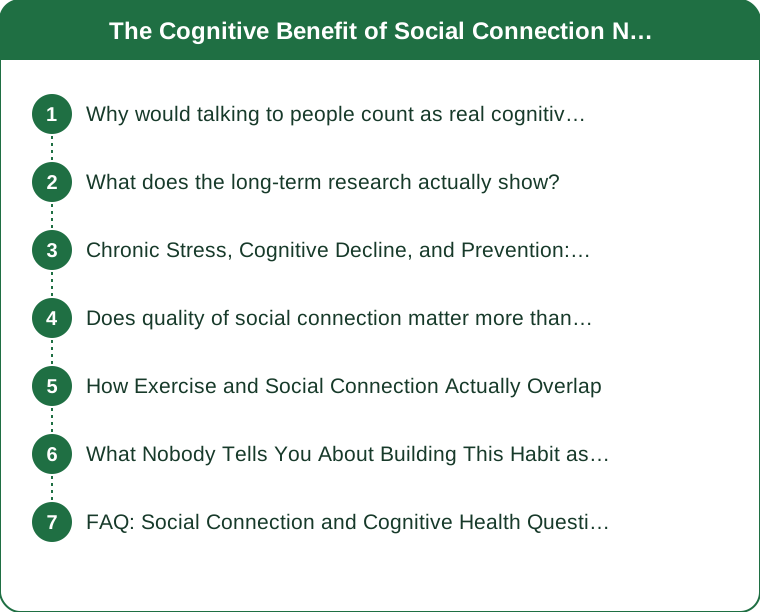
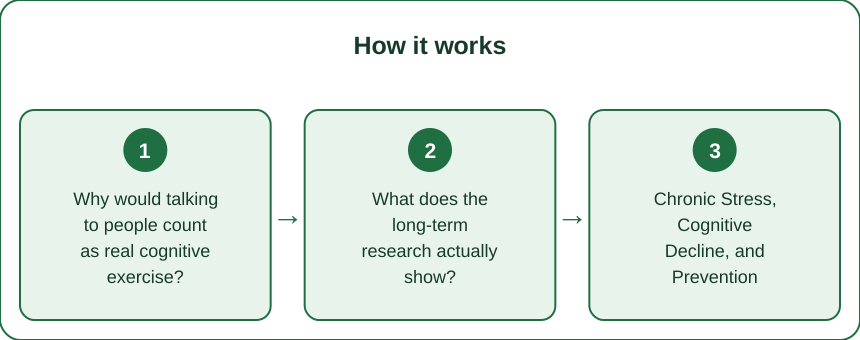
Why would talking to people count as real cognitive exercise?
A genuine conversation requires simultaneous processing across memory (recalling shared context and past details), language (formulating responses in real time), emotional reading (interpreting tone and expression), and executive function (managing turn-taking and staying on topic) — all happening at once, unscripted, and fast.
A crossword or a brain-training app, by comparison, typically isolates a single cognitive skill in a structured, predictable format. That’s not nothing, but it’s a narrower workout than the multi-system demand of real-time social interaction, which is part of why researchers increasingly frame social engagement as its own distinct cognitive protective factor rather than just a mood benefit.
What does the long-term research actually show?
Multiple large longitudinal studies tracking older adults over years have found that greater social engagement — frequency of contact, quality of relationships, participation in group activities — correlates with slower rates of cognitive decline and, in several studies, reduced dementia risk, even after controlling for other health factors.
Loneliness and social isolation, conversely, appear as consistently identified risk factors in dementia research, with some analyses ranking social isolation among the more significant modifiable risk factors alongside better-known ones like hearing loss and physical inactivity. This is correlational research, and it doesn’t prove pure causation on its own — but the consistency across many independent studies makes it hard to dismiss as coincidence.
Chronic Stress, Cognitive Decline, and Prevention: How This Connects
Social isolation and chronic stress are linked in a feedback loop worth understanding: isolation tends to increase perceived stress, and chronically elevated stress hormones are independently associated with effects on brain regions involved in memory, including the hippocampus.
This means social connection isn’t just a separate, parallel protective factor — it may partly work by buffering against the chronic stress pathway that itself damages cognitive function over time. Someone actively managing stress through other means (exercise, sleep, mindfulness) but remaining socially isolated may still be missing a meaningful piece of the protective picture.
Conversely, someone with a strong social network often has an easier time managing stress in the first place, simply from having people to process difficult moments with — the relationship runs in both directions.

Does quality of social connection matter more than quantity?
The research leans toward quality mattering more than raw frequency. A smaller number of close, emotionally genuine relationships appears to offer more protective benefit than a larger number of superficial contacts, though both are better than isolation.
This matters practically: cognitive health advice sometimes implies you need an active, constantly-scheduled social calendar, which can feel unattainable or exhausting for naturally introverted people. The more accurate takeaway is that a few real, sustained relationships — regular calls with one or two close friends, a standing weekly activity with the same small group — likely does more for long-term cognitive health than a wide but shallow social circle.
How Exercise and Social Connection Actually Overlap
Group-based physical activity — a walking group, a class with the same regular attendees, a recreational sports league — captures both protective factors simultaneously: the direct cognitive benefits of exercise plus the cognitive benefits of social interaction, layered together rather than requiring two separate time commitments.
This overlap is part of why group fitness settings show up favorably in some cognitive health research compared to solo exercise of similar intensity — it’s not that solo exercise doesn’t count, but the combined format may be doing double duty for anyone trying to build in both protective habits efficiently.
What Nobody Tells You About Building This Habit as an Adult
Adult friendship maintenance requires actual deliberate structure in a way it didn’t in earlier life stages — school and shared early-career environments used to generate social contact automatically, and most adults eventually lose that built-in structure.
The practical fix that actually works for most people isn’t waiting for connection to happen organically — it’s scheduling it the same way you’d schedule a workout: a standing weekly call, a recurring group activity, a shared hobby with a consistent group. Treating social time as a calendar commitment rather than something that should just happen naturally is, somewhat counterintuitively, what makes it actually happen consistently.
FAQ: Social Connection and Cognitive Health Questions, Answered
Does social media count as social connection for cognitive health?
Most research distinguishes passive scrolling from active engagement — actual back-and-forth interaction (video calls, messaging conversations, in-person contact) appears more protective than passive content consumption, which doesn’t replicate the same cognitive demand.
Is it too late to build this habit if I’m already isolated?
No — research on interventions increasing social engagement in previously isolated older adults has shown measurable benefits, suggesting the protective effect isn’t limited to a lifelong pattern and can be built at any point.
How much social interaction is actually enough?
There’s no single validated number, but research generally associates regular, weekly-or-more meaningful contact with better outcomes than occasional, infrequent contact — consistency appears to matter more than any specific frequency threshold.
TL;DR:
- Real conversation engages more simultaneous cognitive systems than most brain-training apps
- Long-term studies link social engagement to slower cognitive decline; isolation is a consistent risk factor
- Quality of relationships appears to matter more than sheer quantity of contacts
- Group exercise combines two protective factors at once; schedule social time like a workout
The most overlooked brain-health habit isn’t a new app — it’s the phone call you keep meaning to make. This is general information, not medical advice.
Keep Reading
This article is for general informational purposes only and is not medical advice. Always consult a qualified health professional for guidance specific to you.