The Hidden Recovery Time Your Brain Needs After Heavy Multitasking
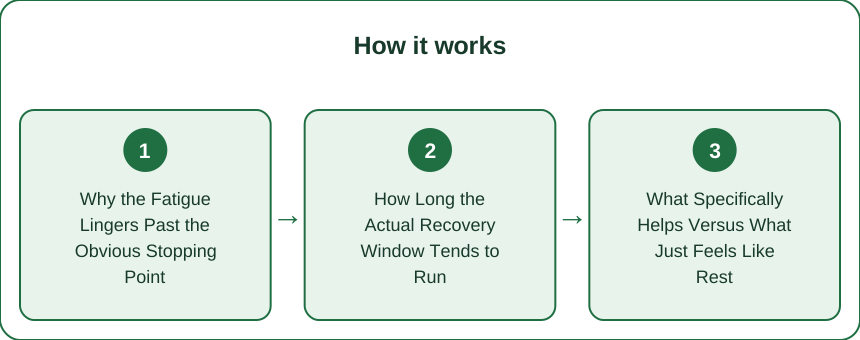
The mental fog after a heavy multitasking stretch doesn’t lift the second the last task is closed, even though that’s when most people expect it to. The brain needs a real recovery window that has almost nothing to do with how tired someone feels in the moment. Here’s why that fatigue lingers past the obvious stopping point, how long the actual recovery window tends to run, and what specifically helps versus what just feels like rest but doesn’t restore the same capacity.

Why the Fatigue Lingers Past the Obvious Stopping Point
The underlying reason: the the-task-switching-costs-accumulate-not-reset-instantly (the each switch between tasks during multitasking carrying a small cognitive cost that builds across a session, a cumulative debt that doesn’t clear the instant the switching stops, echoed in multitasking-actually-damages-focus-guide’s broader case against multitasking — the accumulated-switching-cost-is-a-debt-not-a-single-charge), the the-attentional-residue-carries-over-from-the-last-task (the the mind continuing to partially process an unfinished or recently switched-from task even after moving on, a documented effect that keeps consuming mental resources quietly — the leftover-mental-processing-from-the-last-task-doesnt-stop-on-command), the the-decision-fatigue-compounds-separately-from-general-tiredness (the the sheer number of small decisions made while juggling multiple tasks depleting a separate resource from general physical or sleepy tiredness, one that doesn’t recover through the same means — the decision-fatigue-and-sleepiness-are-different-kinds-of-tired), the the-stress-hormones-take-time-to-clear (the the physiological stress response triggered by a demanding multitasking stretch not dropping back to baseline the instant the stressor ends, following its own biological clearance timeline — the the-body-clears-stress-chemistry-on-its-own-schedule-not-on-command), the the-the-brain-doesnt-distinguish-stopping-from-recovering (the simply ceasing an activity being different from actively recovering from it, a distinction that’s easy to conflate when the tasks themselves have stopped — the stopping-and-recovering-are-not-the-same-event), and the reframe (the lingering fog as a real, measurable recovery process running on its own timeline, not a sign of being unusually tired or unfocused).

How Long the Actual Recovery Window Tends to Run
The rough timeline: the the-attentional-residue-typically-clears-within-fifteen-to-twenty-minutes-of-genuine-disengagement (the research on task-switching suggesting a meaningful chunk of leftover mental processing subsides within roughly this window when the next activity doesn’t demand similar cognitive load — the fifteen-to-twenty-minutes-is-a-reasonable-baseline-not-an-exact-promise), the the-decision-fatigue-recovery-often-takes-longer-than-attentional-residue (the the resource depleted by heavy decision-making during multitasking sometimes taking closer to a full break period — closer to an hour in some contexts — to meaningfully restore, longer than simple attentional residue — the decision-fatigue-runs-on-a-longer-clock-than-simple-distraction-residue), the the-a-short-break-after-light-multitasking-recovers-faster-than-after-heavy-multitasking (the the intensity and number of tasks juggled directly scaling the needed recovery time, meaning a quick check of two apps recovers faster than an hour of constant context-switching across many demands — the recovery-time-scales-with-how-much-switching-actually-happened), the the-recovery-doesnt-happen-passively-during-a-different-demanding-task (the moving straight into another cognitively demanding task not counting as recovery time at all, even if it feels like a break from the specific previous task — the switching-to-a-different-hard-task-isnt-rest-its-just-a-different-load), the the-individual-variation-is-real-and-significant (the baseline cognitive load tolerance, sleep quality, and general stress levels all shifting how long recovery actually takes for any one person on any given day — the the-timeline-is-a-range-not-a-fixed-number-for-everyone), and the frame (the rough range running fifteen minutes for lighter residue up to closer to an hour for heavier decision fatigue, with actual disengagement being the requirement either way).
What Specifically Helps Versus What Just Feels Like Rest
The real distinction: the the-genuinely-low-demand-activity-helps (the something like a slow walk without a podcast or a few minutes of quiet, requiring minimal active decision-making, actually allowing the depleted resource to restore — the truly-low-demand-activity-is-what-recovery-requires), the the-scrolling-a-phone-feels-like-a-break-but-isnt-one (the phone scrolling involving constant micro-decisions and attention shifts that closely resemble the multitasking just finished, meaning it doesn’t provide real recovery despite feeling passive — the scrolling-mimics-multitasking-more-than-it-relieves-it), the the-a-short-outdoor-break-outperforms-an-indoor-one-in-some-research (the natural environments showing some evidence of restoring attention more effectively than an indoor break of the same length, a difference worth factoring into how a break is spent — the where-the-break-happens-may-matter-as-much-as-how-long-it-is), the the-single-tasking-immediately-after-is-itself-part-of-the-recovery (the deliberately doing one thing at a time right after a heavy multitasking stretch, rather than easing back into more switching, giving the depleted system room to actually recover rather than immediately redepleting — the single-tasking-after-multitasking-is-recovery-not-just-a-nice-idea), the the-sleep-is-the-largest-lever-but-not-available-mid-day (the a full night of quality sleep clearing far more accumulated fatigue than any short break can, per sleep-memory-consolidation-guide’s broader case for sleep’s cognitive role, though that’s obviously not a mid-workday option — the sleep-is-the-real-reset-short-breaks-are-a-partial-substitute), and the frame (the real recovery activities being low-demand, ideally outdoor, and free of the same switching pattern — with phone scrolling being the most common false break people mistake for genuine rest).
The mental fog after heavy multitasking doesn’t clear the moment the tasks stop, because attentional residue, decision fatigue and stress chemistry each run on their own recovery timeline that has nothing to do with when the activity itself ended — typically fifteen to twenty minutes for lighter residue, closer to an hour for heavier decision fatigue. What actually helps is genuinely low-demand activity, ideally without a screen and ideally outdoors, since phone scrolling mimics the same switching pattern that caused the fatigue in the first place rather than relieving it. A full night’s sleep remains the biggest lever by far, but a real, low-demand break in the moment is the closest available substitute — and it only works if it’s actually low-demand, not just a different flavor of busy.
Keep Reading
This article is for general informational purposes only and is not medical advice. Always consult a qualified health professional for guidance specific to you.