The Complete Guide to Building Cognitive Resilience in Your 40s and Beyond
Quick Answer: Cognitive resilience in your 40s and beyond is built through a combination of regular aerobic exercise, quality sleep, ongoing mental challenge (learning genuinely new skills, not just familiar puzzles), strong social connection, and stress management — no single habit substitutes for the others, and the combined, consistent effect matters more than any one intervention alone.
Most cognitive health advice picks one lever — exercise, or diet, or puzzles — and treats it as the whole answer. The actual evidence points to a combination, sustained over years, being what genuinely matters.

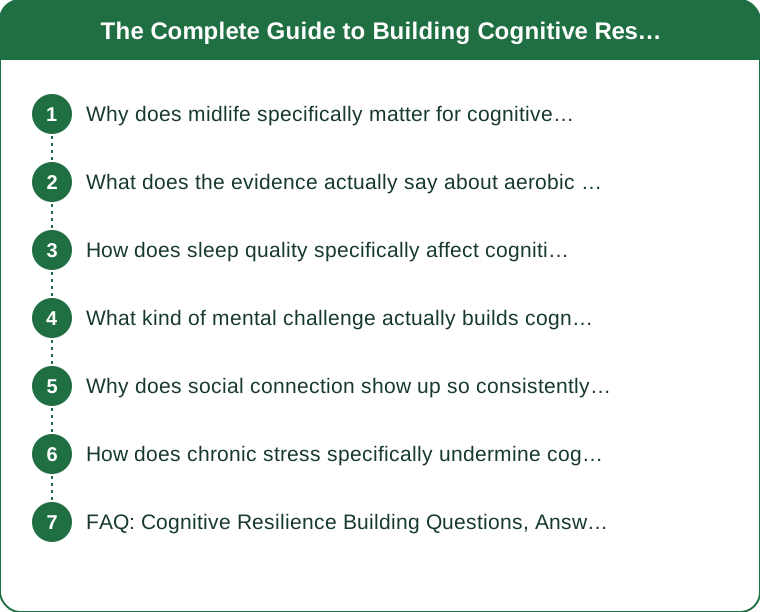
Why does midlife specifically matter for cognitive resilience building?
Research increasingly points to midlife (roughly the 40s and 50s) as a meaningful window for influencing long-term cognitive trajectory, since habits and interventions established during this period appear to have measurable downstream effects on cognitive health decades later, well before any noticeable decline would otherwise begin.
This doesn’t mean earlier or later starts don’t matter — they do — but midlife specifically combines still-high brain plasticity with enough life experience and often more stable routines to actually sustain new habits long-term, which is a genuine advantage over trying to build these same habits either very early (when other priorities often dominate) or very late (after some decline may have already begun).
The encouraging framing here is that cognitive resilience isn’t fixed by genetics alone — lifestyle factors are estimated to account for a substantial portion of cognitive aging trajectory in current research, meaning the habits built starting now genuinely matter for outcomes decades down the line.
What does the evidence actually say about aerobic exercise and brain health?
Aerobic exercise has some of the strongest research support of any single lifestyle intervention for cognitive health, associated with increased blood flow to the brain, support for the growth of new neural connections, and in some studies, actual measurable increases in the size of brain regions associated with memory.
The general guidance is roughly 150 minutes of moderate aerobic activity weekly — brisk walking, cycling, swimming — though research suggests even amounts below this threshold still provide meaningful benefit compared to a fully sedentary baseline, so this shouldn’t be treated as an all-or-nothing target.
Consistency over years matters more than intensity in any single session — this is a long-game intervention, not something that shows measurable cognitive benefit from a single workout or even a single month of consistent exercise, which is part of why it’s easy to underestimate its importance in the moment.
How does sleep quality specifically affect cognitive resilience?
Sleep plays a direct, mechanistic role in cognitive health beyond simply feeling rested — during deep sleep specifically, the brain’s glymphatic system becomes more active, clearing metabolic waste products, including proteins associated with cognitive decline, that accumulate during waking hours.
Chronic sleep deprivation, even moderate and ongoing rather than acute, is associated in research with measurably worse performance on memory and cognitive tasks, and some research suggests a link between poor sleep in midlife and increased long-term cognitive decline risk, though this research area continues to develop.
Prioritizing consistent sleep timing, not just duration, appears to matter as well — an irregular sleep schedule, even with adequate total hours, disrupts the circadian rhythm patterns that support optimal deep sleep stages where much of this cognitive maintenance work happens.

What kind of mental challenge actually builds cognitive resilience, versus just passing time?
Genuinely novel mental challenge appears to matter more than familiar mental activity — completing the same crossword puzzle format daily, for example, engages already well-established neural pathways rather than building new ones, while learning an actually new skill (a language, an instrument, a new complex hobby) forces the brain to build new connections.
This is sometimes called ‘cognitive reserve’ building — the theory being that a brain with more varied, well-developed neural pathways has more capacity to compensate if some pathways are later affected by age-related changes, functioning similarly to a backup system with more redundancy built in.
The specific activity matters less than the genuine novelty and difficulty level — an activity that’s too easy provides minimal cognitive challenge, while something appropriately difficult (requiring real, sustained effort to improve at) appears to provide more benefit, which is why picking up something entirely new tends to outperform additional practice at something already familiar.
Why does social connection show up so consistently in cognitive resilience research?
Strong social connection is one of the more consistently replicated protective factors in cognitive aging research, with socially isolated individuals showing measurably higher rates of cognitive decline in long-term studies compared to those with regular, meaningful social engagement.
The proposed mechanisms include both the cognitive complexity of social interaction itself (following conversation, reading social cues, and responding in real time is genuinely demanding cognitive work) and the indirect protective effect of social connection against depression and chronic stress, both of which independently affect cognitive health.
Quality of connection appears to matter more than sheer quantity of social contact — a smaller number of genuinely meaningful relationships shows stronger association with cognitive protection in research than a larger number of superficial contacts, which is a useful distinction for anyone assuming more social activity automatically means more benefit.
How does chronic stress specifically undermine cognitive resilience, and what actually helps?
Chronic, sustained stress elevates cortisol over extended periods, and research links prolonged cortisol elevation to measurable changes in brain regions associated with memory, including the hippocampus, over time — this is distinct from the normal, adaptive stress response to a single acute stressor, which doesn’t carry the same long-term risk.
Stress management practices with genuine research support include regular exercise (which also serves the aerobic benefit above), mindfulness or meditation practice, and adequate sleep — these aren’t separate interventions from the others discussed here, but genuinely compound with them, which is part of why a combined approach outperforms any single lever pulled in isolation.
Recognizing chronic stress early, rather than normalizing it as an unavoidable part of a busy midlife schedule, is itself a meaningful first step — many people don’t register genuinely chronic stress as a health concern requiring active management until symptoms become significant, well past the point where earlier intervention would have been easier.
FAQ: Cognitive Resilience Building Questions, Answered
Do brain-training apps and games actually build cognitive resilience?
Evidence is mixed — most research suggests these apps improve performance specifically on the trained task itself, with less consistent evidence of broader transfer to general cognitive resilience, compared to the more robustly supported interventions like aerobic exercise and genuinely novel skill learning.
How long before these habits show a measurable cognitive benefit?
Most of this research operates on a timeline of years, not weeks or months — the honest framing is that these are long-term investments in cognitive trajectory, not short-term interventions with quick, measurable results.
Is it worth starting these habits if I’m already past my 40s?
Yes — while midlife is a particularly emphasized window in current research, cognitive resilience-building habits show benefit when started at essentially any adult age, including later decades. This is general information, not medical advice, and any specific cognitive concerns should be discussed with a doctor.
TL;DR:
- Aerobic exercise has some of the strongest research support of any single intervention
- Sleep plays a direct mechanistic role, not just a restorative one, in cognitive maintenance
- Genuinely novel mental challenge builds more cognitive reserve than familiar activities
- Quality social connection is a consistently replicated protective factor
- Chronic stress management compounds with the other habits rather than standing apart
This is general information, not medical advice — specific cognitive concerns deserve a conversation with your doctor, not just a lifestyle checklist.
Keep Reading
This article is for general informational purposes only and is not medical advice. Always consult a qualified health professional for guidance specific to you.