The Complete Guide to Slowing Cognitive Decline Through Daily Habits
Quick Answer: Regular aerobic exercise, consistent quality sleep, ongoing social connection, ongoing novel learning, and managing cardiovascular risk factors (blood pressure, blood sugar) together produce the strongest evidence-backed protection against age-related cognitive decline — no single habit works alone.
Cognitive decline gets talked about as though it’s a coin flip of genetics, but a large and growing body of research points to daily habits carrying more weight than most people assume, compounding over decades rather than years.

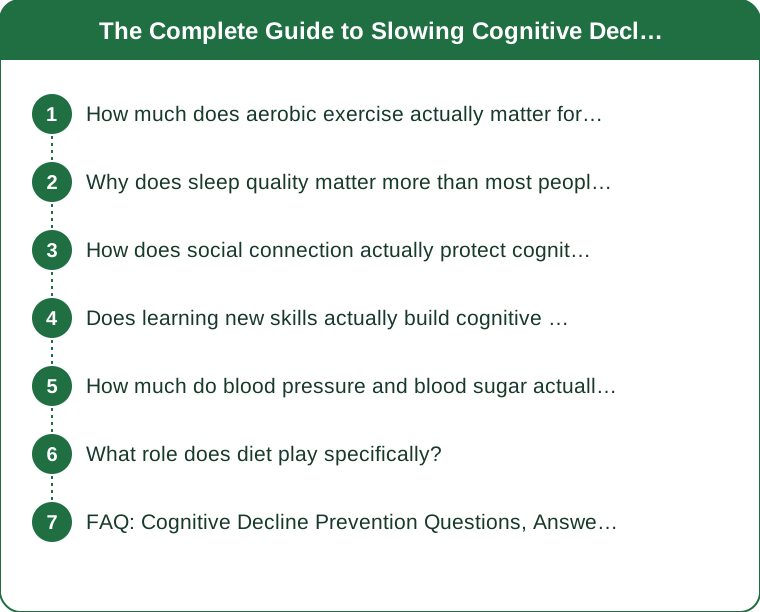
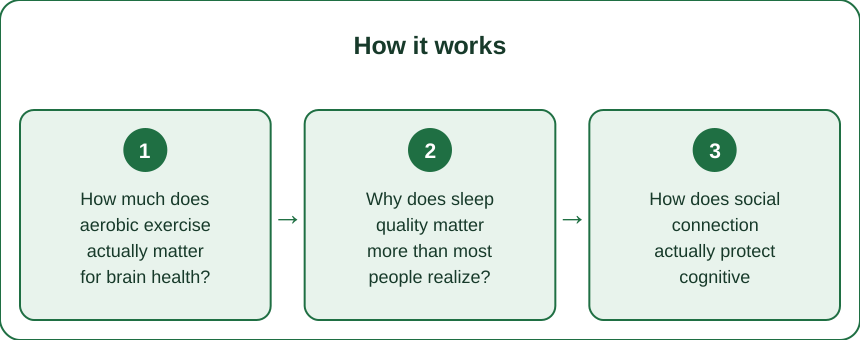
How much does aerobic exercise actually matter for brain health?
Aerobic exercise increases blood flow to the brain and promotes the release of brain-derived neurotrophic factor (BDNF), a protein that supports the growth of new neural connections. Studies following adults over multiple decades consistently find that those who maintain regular moderate aerobic activity — roughly 150 minutes a week of brisk walking, cycling, or swimming — show measurably slower rates of hippocampal shrinkage, the brain region most associated with memory, compared to sedentary peers.
The effect isn’t limited to any one life stage either; starting regular aerobic activity in your 40s, 50s, or even 60s still shows measurable cognitive benefit within a year of consistent practice, which counters the common assumption that the window for meaningful intervention closes early.
Why does sleep quality matter more than most people realize?
During deep sleep, the brain’s glymphatic system actively clears metabolic waste products, including amyloid-beta, a protein associated with Alzheimer’s disease when it accumulates excessively. Chronic sleep deprivation or poor sleep quality — even without a formal disorder — impairs this clearance process over years, meaning consistent 7-9 hour sleep isn’t just about feeling rested the next day, it’s part of the brain’s actual maintenance cycle.
Sleep apnea in particular deserves specific attention here, since it fragments deep sleep stages repeatedly through the night without necessarily causing the person to fully wake or remember waking, making it an under-diagnosed contributor to accelerated cognitive decline that a simple conversation with a doctor about snoring and daytime fatigue can help catch.
How does social connection actually protect cognitive function?
Regular social interaction requires ongoing, complex cognitive work — following conversation, reading social cues, recalling shared history — that functions as a kind of continuous cognitive exercise most people don’t think of as brain training. Longitudinal studies tracking older adults find that those with larger, more active social networks show slower rates of decline on standardized cognitive testing than socially isolated peers, even after controlling for other health factors.
This is part of why isolation is increasingly treated as a genuine risk factor in cognitive health research, not just a quality-of-life issue — the mechanism appears to be the cognitive demand of maintaining relationships itself, not simply mood benefits from feeling connected.

Does learning new skills actually build cognitive reserve?
Novel, effortful learning — a new language, a musical instrument, a genuinely unfamiliar skill rather than a familiar hobby — appears to build what researchers call cognitive reserve, essentially extra capacity that allows the brain to sustain more damage before symptoms of decline become apparent. This is distinct from routine mental activity like crossword puzzles, which mostly exercise skills you already have rather than building new neural pathways.
The research consistently favors genuinely difficult, unfamiliar learning over easy, repetitive brain games, which is why picking up something you’re bad at initially (a new language, an instrument) tends to build more reserve than an activity you’re already comfortable with.
How much do blood pressure and blood sugar actually matter?
Cardiovascular risk factors — high blood pressure, high blood sugar, high cholesterol — damage the small blood vessels that supply the brain over years, a mechanism now understood to contribute significantly to vascular cognitive decline, a category distinct from but often overlapping with Alzheimer’s-type decline. Managing these factors in midlife (40s-60s specifically) shows a particularly strong protective association with later cognitive outcomes.
This is one of the more actionable findings in the field, since blood pressure and blood sugar are both measurable and modifiable through diet, exercise, and medication when needed, unlike genetic risk factors that can’t currently be changed.
What role does diet play specifically?
The Mediterranean and MIND diets — both emphasizing leafy greens, berries, nuts, olive oil, and fish while limiting red meat and processed food — show the strongest research association with slower cognitive decline among dietary patterns studied. The MIND diet in particular was designed specifically around foods with the most consistent neuroprotective research backing, rather than general healthy-eating principles.
No single food or supplement has shown the same strength of evidence as the overall dietary pattern, which is worth noting given how heavily individual “brain food” supplements are marketed compared to their actual research support.
FAQ: Cognitive Decline Prevention Questions, Answered
At what age should I start focusing on cognitive decline prevention?
Earlier is better, but research shows meaningful benefit from starting these habits even in your 50s or 60s — it’s never too late for measurable impact.
Do brain training apps actually work?
Most commercial brain-training apps improve performance on the specific game trained, but evidence for that improvement transferring to real-world cognitive function is weak — genuinely novel, effortful learning outperforms most apps.
Is memory loss always a sign of serious cognitive decline?
No — occasional forgetfulness is normal at any age; the concerning pattern is progressive difficulty with daily tasks, not isolated memory lapses. This is general information, not medical advice, and any concerning symptoms should be discussed with a doctor.
TL;DR:
- Regular aerobic exercise measurably slows hippocampal shrinkage at any starting age
- Deep sleep actively clears brain waste products linked to cognitive decline
- Social connection functions as ongoing cognitive exercise, not just mood support
- Genuinely novel, effortful learning builds more cognitive reserve than familiar hobbies
- Managing blood pressure and blood sugar in midlife shows strong protective association
This is general information, not medical advice — but the through-line across all the research is consistency over years, not any single dramatic intervention.
Keep Reading
This article is for general informational purposes only and is not medical advice. Always consult a qualified health professional for guidance specific to you.