The Caffeine Timing Mistake That's Quietly Wrecking Your Afternoon Focus
Quick Answer: Caffeine has a half-life of roughly 5-6 hours, meaning a 2pm coffee still has half its effect in your system at 8pm — the real focus problem isn’t caffeine itself, it’s timing intake around your natural energy dips instead of reactively drinking coffee the moment focus drops.
You reach for coffee the instant your attention starts drifting, every single afternoon, and every single afternoon it helps for twenty minutes and then makes things worse. The problem was never the coffee. It was exactly when you drank it.

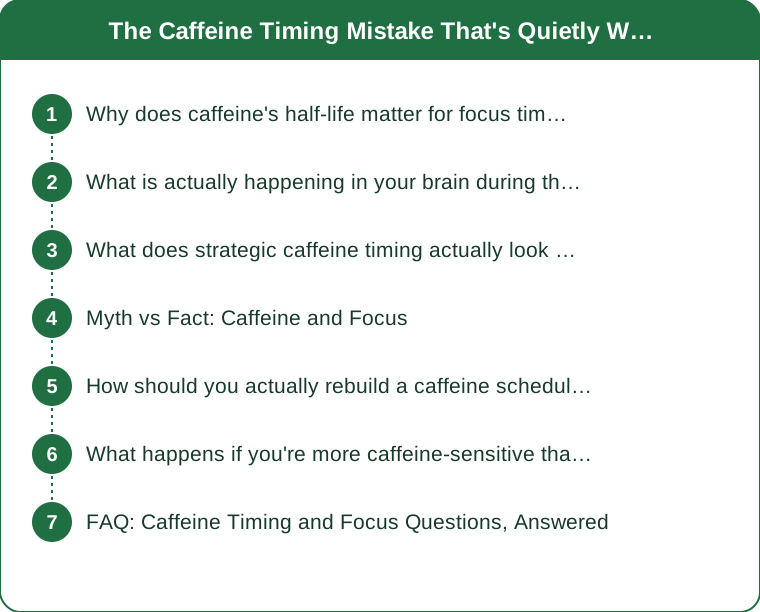
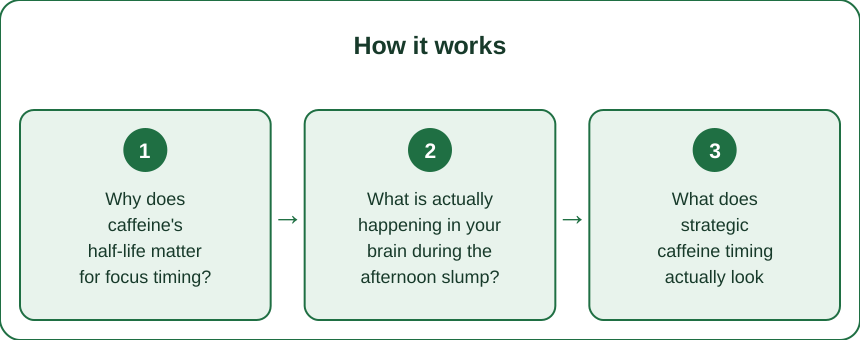
Why does caffeine’s half-life matter for focus timing?
Because caffeine doesn’t clear your system quickly — a typical half-life of 5-6 hours means roughly half the caffeine from a 2pm cup is still active at 7-8pm, and a meaningful amount remains even longer for slow metabolizers. That lingering caffeine is a major reason sleep quality suffers, which in turn wrecks the following day’s focus in a compounding cycle few people connect back to yesterday’s afternoon coffee.
The half-life also explains why reactive caffeine — drinking it only once you’ve already crashed — puts you chasing a deficit instead of preventing one. By the time focus visibly drops, cortisol and adenosine dynamics are already working against you, and caffeine needs 20-45 minutes to meaningfully counteract that.
Understanding this timeline is the difference between caffeine as a focus tool and caffeine as a sleep-disrupting habit that creates the very fatigue it’s meant to fix.
What is actually happening in your brain during the afternoon slump?
Two separate mechanisms typically converge in early-to-mid afternoon: a natural dip in circadian alertness (a well-documented dip distinct from sleep debt, occurring even in well-rested people), and a post-lunch digestive shift in blood flow and blood sugar that compounds it.
Caffeine addresses the adenosine-blocking piece of alertness reasonably well, but it does nothing for the blood-sugar component — which is part of why a coffee-only response to the afternoon slump often feels incomplete or short-lived compared to pairing it with a lighter lunch or a short walk.
Recognizing that the slump has two separate causes, not one, is useful because it means caffeine alone was never going to fully solve it, regardless of timing.
What does strategic caffeine timing actually look like?
Rather than drinking coffee reactively when focus drops, timing intake 30-45 minutes before a known dip works with the half-life curve instead of chasing it — for most people with a 1-2pm slump, that means a coffee around 12:15-12:30pm, not at 2pm once attention has already scattered.
Equally important is a cutoff time on the other end: given the 5-6 hour half-life, most sleep researchers suggest no caffeine after roughly 2pm for people sensitive to its sleep effects, since a 3pm cup can still be meaningfully active at bedtime for many people.
This reframes caffeine from ‘reach for it when tired’ to ‘place it ahead of the dip, and stop it early enough to protect the following night’s sleep’ — a genuinely different mental model than most people currently use.

Myth vs Fact: Caffeine and Focus
Myth: More caffeine always means more focus. Fact: Past a moderate dose (roughly 200-400mg/day for most adults), additional caffeine tends to increase jitteriness and anxiety rather than proportionally improving focus — it’s a curve with a peak, not a straight line.
Myth: Afternoon coffee doesn’t affect sleep if you fall asleep fine. Fact: Caffeine can reduce deep sleep quality even when it doesn’t prevent falling asleep, which shows up the next day as reduced focus without an obvious cause.
Myth: Tolerance means caffeine stops affecting your sleep. Fact: Tolerance reduces the subjective stimulant feeling faster than it reduces the actual sleep-disrupting effect — regular users often still show measurable sleep impact from late caffeine despite feeling unaffected.
How should you actually rebuild a caffeine schedule around focus?
Start by mapping your typical energy dip times over a few days without changing anything, then move your usual caffeine intake to 30-45 minutes ahead of the dip rather than during it. Set a hard cutoff around early-to-mid afternoon based on your own sleep sensitivity.
Pair caffeine timing with the blood-sugar half of the slump — a lighter, more protein-forward lunch and a 5-10 minute walk address the piece caffeine timing alone can’t reach. Together, these two changes tend to outperform simply drinking more coffee later in the day.
What happens if you’re more caffeine-sensitive than average?
Genetic variation in the CYP1A2 enzyme, which metabolizes caffeine, means some people clear it meaningfully faster or slower than the population-average half-life — ‘slow metabolizers’ can have caffeine still active well past 8-10 hours, making even a lunchtime coffee a sleep risk.
If you consistently sleep poorly regardless of how early you stop caffeine, or feel jittery on doses others tolerate easily, treating yourself as caffeine-sensitive and shifting your cutoff earlier (or lowering total dose) is a more useful strategy than assuming general population guidance applies exactly to you.
FAQ: Caffeine Timing and Focus Questions, Answered
What’s the ideal time to drink coffee in the morning?
Many sleep researchers suggest waiting 60-90 minutes after waking, since cortisol is naturally elevated right after waking and caffeine’s effect is somewhat blunted during that window.
Does caffeine timing matter if I don’t drink it every day?
Less so — tolerance and habitual timing patterns matter more for regular daily drinkers. Occasional use is more forgiving of timing.
How long before bed should I stop drinking caffeine?
A common guideline is 6-8 hours before bed, though caffeine-sensitive individuals may need a longer buffer given the 5-6 hour half-life.
TL;DR:
- Caffeine’s 5-6 hour half-life means afternoon coffee lingers into the evening and can quietly damage sleep
- The afternoon slump has two causes — circadian dip and post-lunch blood sugar — caffeine only addresses one
- Time caffeine 30-45 minutes ahead of a known dip, not reactively after focus has already dropped
- Genetic variation in caffeine metabolism means some people need an earlier cutoff than general guidance suggests
This is general information, not medical advice — individual caffeine sensitivity varies, so adjust timing based on your own sleep response.
Keep Reading
This article is for general informational purposes only and is not medical advice. Always consult a qualified health professional for guidance specific to you.